

November 26th, 2025 | 9 min. read
Learn how to find the perfect dishwasher with our Dishwasher Buying Guide

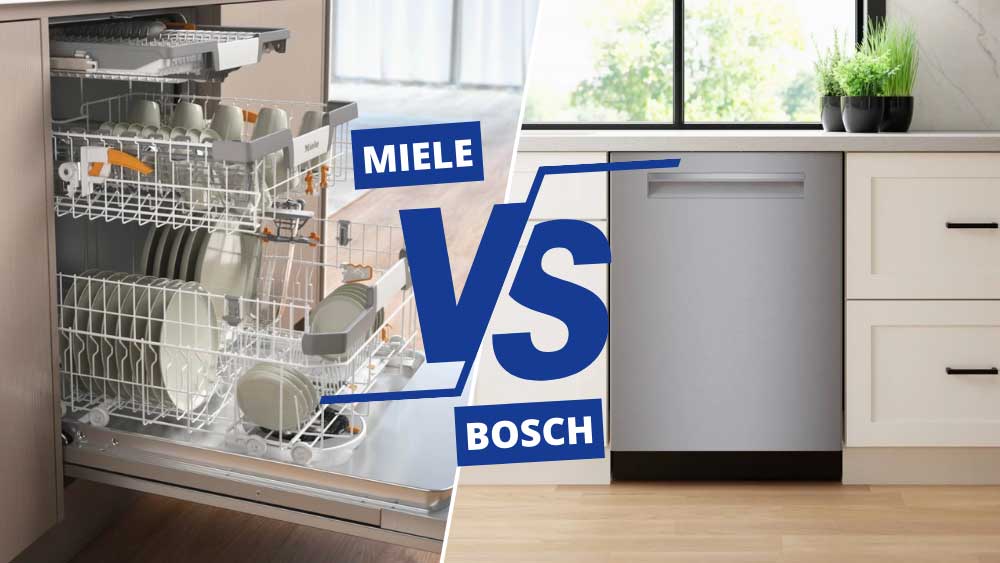
If you’re comparing Bosch and Miele, you’re already in the right aisle.
Both brands are excellent and that is your dilemma
So how do you choose?
The trick is picking the one that solves your daily headache—cloudy glasses, wet plastics, awkward racks, or running during movie night.
In this latest Bosch vs. Miele comparison, we line up their three most common matchups and show real-world reliability based on 33,000+ service calls.
You’ll see where they are evenly matched, where they aren’t, and the one issue that should tip the acles (no its not a wash feature).
Let’s start with reliability.
📽️ Prefer a Video?
This video compares Bosch and Miele dishwashers for reliability, quietness, cleaning, drying, and key features like Bosch CrystalDry and Miele AutoDose.
You’ll learn which models are the best value for you and why local repair service can matter more than small reliability differences.
Bosch vs. Miele Dishwashers: Which Is More Reliable?
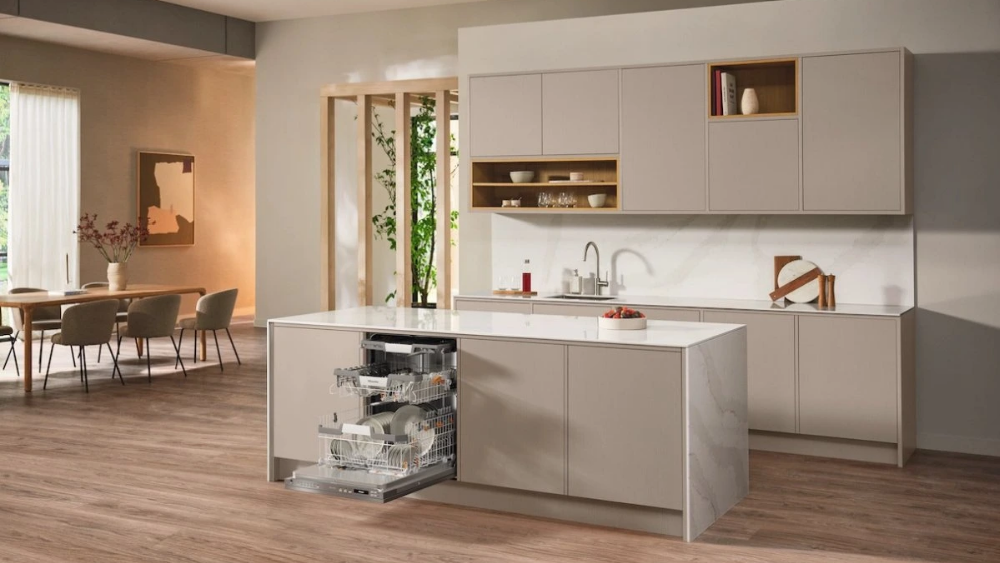
⚡Quick Takeaway: For 2026, Miele is our most reliable dishwasher brand at 5.6% service, making it 2.2% more reliable than Bosch in the first year.
When a dishwasher breaks, it’s not just an inconvenience. You’re suddenly juggling dirty dishes, long service wait times, and hoping the technician shows up with the right part.
Dishwashers also fall to the bottom of the service priority list. Refrigerators and ranges are fixed first, dishwashers last.
That’s why reliability matters. It saves you time, frustration, and the stress of a backed-up kitchen.
Bosch vs. Miele: Head-to-Head Reliability
| 12-Month Service Rate* | Direction vs. Last Year | What It Means for You | |
| Miele | 5.6% | Improvement: down from 10.1% | Our most reliable dishwasher brand for 2026. Excellent build quality and wash performance with fewer re-washes. |
| Bosch | 7.8% | Improvement: down from 9.5% | Historically among the lowest service rates in our data. Quiet, consistent, and well-engineered. |
Miele is the most reliable dishwasher brand for 2026.
It’s 2.2% more reliable than Bosch in the first year based on actual repairs.
What Miele Does Well (and Where It Falls Short)
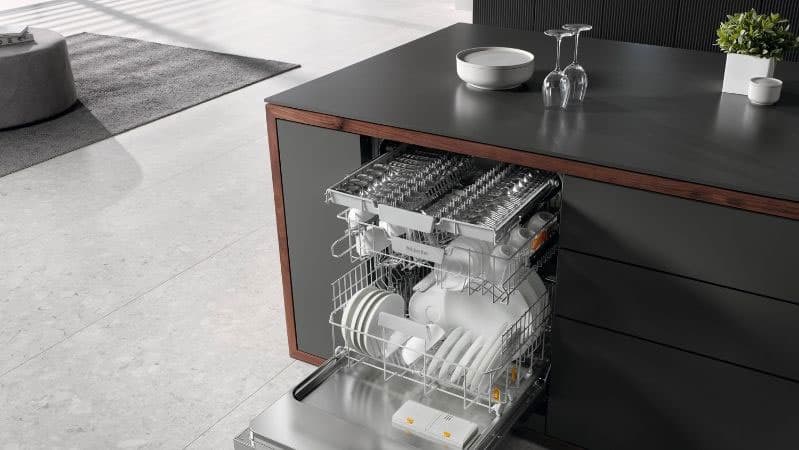
Miele builds nearly all of its parts in-house at its factory in Germany, which gives them tighter control over quality and parts availability.
That shows up in the numbers: they’re not perfect, but they are the lowest-risk brand for a first-year repair.
They’re also the only brand with auto dosing. The PowerDisk system stores up to 20 loads of detergent and dispenses the right amount at the right time based on soil level.
That reduces one of the biggest user errors—using too much or too little detergent—which can lead to poor cleaning or long-term issues.
Miele’s wash system is excellent for fine china, crystal, and mixed loads, and their drying system uses cooler air to condense steam and automatically opens the door at the end of the cycle.
Drawback:
After tariffs and recent price increases, most Miele dishwashers now start above $2,500. That’s roughly double what many people plan to spend on a dishwasher.
Best fit:
Choose Miele if you want the lowest chance of service, top-to-bottom build quality, and advanced washing technology and you’re comfortable with the higher price.
What Bosch Does Well (and Where It Falls Short)
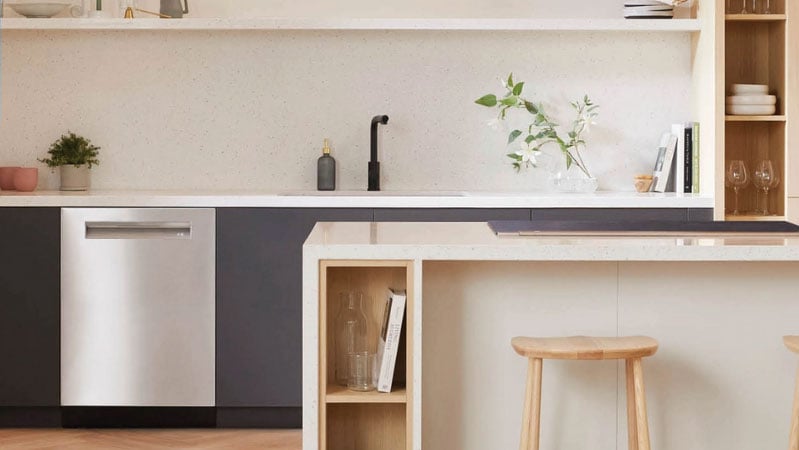
Bosch was the first major brand to focus on quiet, well-featured dishwashers back in the 1990s.
As kitchens opened into living spaces, noise became a big deal. Bosch leaned into that early.
Most Bosch models run between 38 and 44 dB, which is ideal for open layouts where you don’t want to hear the dishwasher during dinner or a movie.
A dishwasher at 44 dB or less is considered quiet.
Bosch, Bosch Benchmark, and Thermador all share the same platform, built in North Carolina.
The differences are mainly in features and price, not in the core engineering. That’s why their reliability rates are so close:
- Bosch Benchmark: 7.7%
- Bosch: 7.8%
- Thermador: 8.1%
Bosch also leads in drying technology:
- CrystalDry (800 and Benchmark Series) uses zeolite minerals to absorb moisture and emit heat, improving plastic drying.
- AutoAir (500 Series) automatically pops the door open at the end of the cycle to let steam escape and speed drying.
Drawback:
The Bosch 100 Series uses more plastic inside and doesn’t match the overall feel and features of the higher series.
It’s still a decent machine, but you don’t get the same experience as a 500, 800, or Benchmark.
Best fit:
Choose Bosch if you want quiet, reliable performance, strong drying, and a wide range of price points, from entry-level to high-end.
How We Calculate Reliability
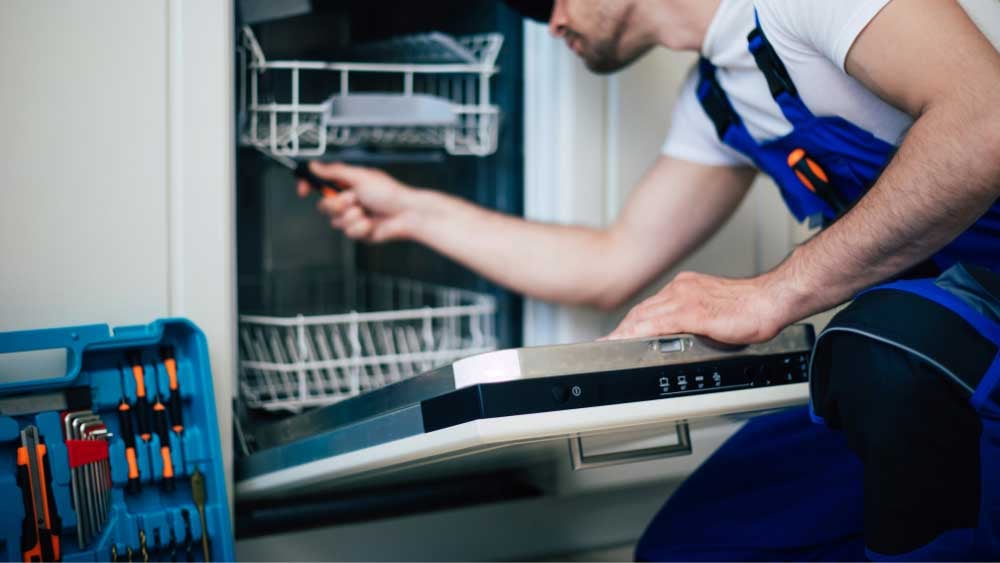
We don’t use surveys or online reviews. Instead, we use something more concrete: our own service records.
- We track every repair call.
- Then we divide that number by the number of dishwashers sold over the same 12-month period.
- That gives us the service rate:
Service rate = units serviced ÷ units sold within 12 months. Lower is better.
In 2025, we logged 33,190 real service calls across Boston, Cape Cod, and Southern New Hampshire.
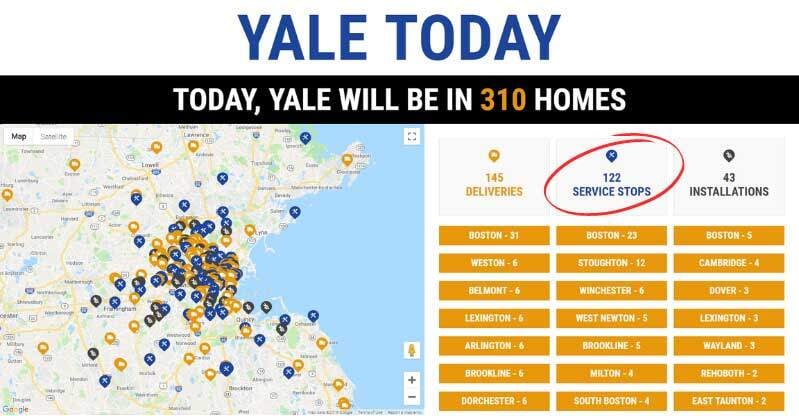
No opinions. No affiliate links. Just actual repair data from the people who fix these machines every day.
This is the most honest way to measure reliability: not what people think might break, but what actually does.
Dishwasher Reliability for 2026 (All Brands)
These service rates are based on:
- A minimum of 150 units sold per brand
- A total sample size of over 7,000 dishwashers
- First-year service only
| 12-Month Service Rate* | |
| Miele | 5.6% |
| Bosch Benchmark | 7.7% |
| Bosch | 7.8% |
| Thermador | 8.1% |
| KitchenAid | 8.2% |
| GE | 8.9% |
| GE Profile | 10.3% |
| LG | 11.6% |
| Fisher & Paykel | 16.6% |
| Café | 16.6% |
| Overall Service Rate | 8.8% |
Overall average (all brands): 8.8%.
*12-month service rate based on products we sold and serviced within the first year.
So, Bosch or Miele?
- Choose Miele if you want the lowest odds of a repair and the most advanced washing system, and you’re okay spending more.
- Choose Bosch if you want quiet, reliable performance with strong drying and more options under $2,000.
Both are good. Miele is more reliable on paper. Bosch often wins on value and noise.
🔍 Read More: The Most Reliable Dishwashers
Noise (Why This Isn't a Noise Comparison)
This is not a noise comparison. Both Bosch and Miele meet the ≤44 dB standard for a quiet dishwasher.
In real kitchens, ≤44 dB is effectively silent—so we focus on what you’ll actually notice (washing consistency, plastics drying, racks, and service).
Yes, Bosch offers models down to 38 dB, but the day-to-day difference from 44→38 is subtle for most homes. Spend on CrystalDry or AutoDos, not on a couple of decibels.
Looking for answers about Dishwashers?
Short on time? Download our free Dishwasher Buying Guide.
Bosch vs. Miele: Head-to-Head at Each Price Level
| Bosch 500 | Miele G 5056 | Bosch 800 | Miele G 5256 | Bosch Benchmark | Miele G 7156 | |
| Core drying tech | Auto-open door (AutoAir) | Condensation dry cool-air mixing (CleanAir) | CrystalDry (zeolite) | Auto-open + cool-air mixing | CrystalDry (zeolite) | Auto-open + cool-air mixing |
| Plastics drying | Good | OK | Best-in-class | Very good | Best-in-class | Very good |
| Washing approach | PrecisionWash sensing | 3 full spray arms (incl. real top arm) | PrecisionWash + PowerControl zones | 3 full spray arms | PrecisionWash + PowerControl zones | 3 full spray arms |
| Detergent/dosing | Manual/pods | Manual/pods | Manual/pods | Manual/pods | Manual/pods | AutoDos (PowerDisk) |
| Third rack | Yes | 3D cutlery tray | Yes / Flexible 3rd rack | 3D cutlery tray | Flexible 3rd rack | 3D cutlery tray |
| Rack flexibility | Good | Excellent (orange-tab fold-downs) | Good–Very good | Excellent | Very good | Excellent |
| Noise (typical) | ≤44 dB | ≤44 dB | 42–39 dB | ≤44 dB | 38 dB | ~42–44 dB |
| Leak protection | AquaStop | Double-wall tub | AquaStop | Double-wall tub | AquaStop | Double-wall tub |
| Smart/app | Yes (Home Connect) | Yes | Yes | Yes | Yes | Yes |
| Best for | Quiet value | Fitted racks, clean finish | Dry plastics, mixed loads | Strong wash coverage | Ultra-quiet + CrystalDry | Set-it-and-forget-it wash + AutoDos |
| Not ideal if… | You want premium drying | You need zeolite-level plastic dry | You don’t load plastics | You want zone control | You don’t need 38 dB/CrystalDry | You prefer pods and won’t use AutoDos |
Price-Equivalent Matchups (past 12 months)
This keeps finishes/handles out and compares the platforms people actually cross-shop.
| Typical Street Price Range | Promo Floor (holiday dips) | What changes at this tier | |
| Bosch 500 (AutoAir) vs Miele G 5056 | Bosch 500: $899–$1,149 • Miele 5056: $1,099–$1,299 | Bosch: ~$849 • Miele: ~$1,049 | Bosch has auto-open; Bosch hits a lower price; Miele’s racks feel more “fitted.” |
| Bosch 800 (CrystalDry) vs Miele G 5256 | Bosch 800: $1,299–$1,599 • Miele 5256: $1,299–$1,499 | Bosch: ~$1,199 • Miele: ~$1,249 | CrystalDry wins plastics; Miele steps up wash coverage vs 5056. |
| Bosch Benchmark (CrystalDry, 38 dB) vs Miele G 7156 (AutoDos) | Benchmark: $1,599–$1,999 • Miele 7156: $1,699–$2,199 | Benchmark: ~$1,499 • Miele: ~$1,599 | Bosch = ultra-quiet + CrystalDry; Miele = AutoDos + most flexible racks. |
Wondering how Bosch and Miele stack up to KitchenAid, LG, and GE Profile? Download our Free Dishwasher Buying Guide — trusted by over 1 million homeowners.
We install Bosch and Miele dishwashers within 48 hours in Greater Boston through Cape Cod (based on appointment availability).
Looking for answers about Dishwashers?
Short on time? Download our free Dishwasher Buying Guide.
Three Real Head-to-Heads (What Changes As You Move Up)
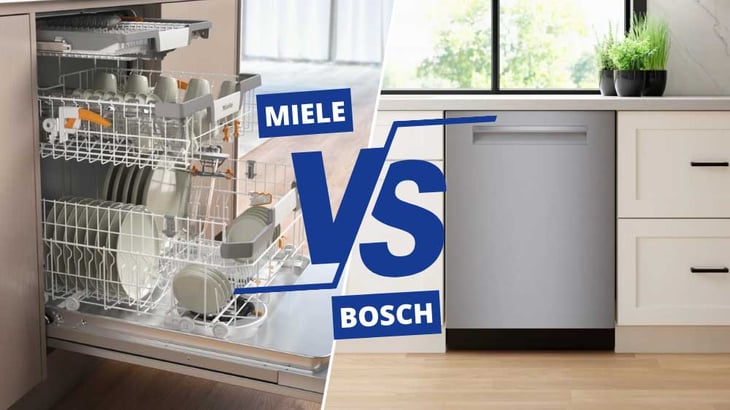
Let's now compare specific dishwasher models from Miele and Bosch.
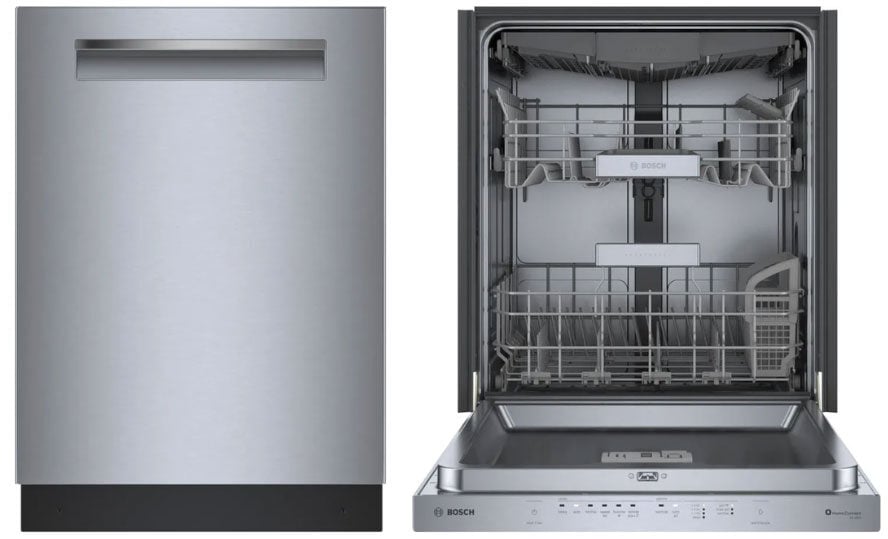
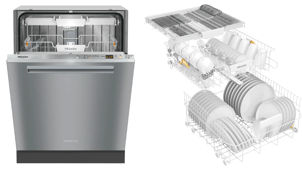
1) Bosch 500 vs. Miele G 5056 — base-level quiet with smarter drying/racking on Miele
Drying
.jpg?width=799&height=449&name=Bosch%20SHP65CP5N%20dishwasher%20(3).jpg)
Bosch has open air dry (shown above). Miele has condensation dry. However, Miele also brings in cooler room air through its CleanAir port. Cool + hot air mix, moisture condenses, and drains.
Result: a little better drying but not as good as the Bosch 500, especially on glass/ceramics and plastics..
Racks
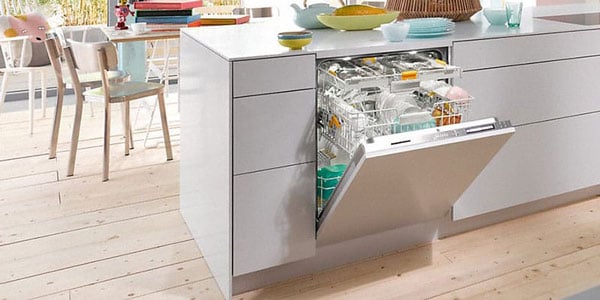
Miele’s 3D cutlery tray holds flatware in place; orange-tab fold-downs help with odd shapes. Bosch’s third rack is good; Miele’s feels more “fitted.”
Net
If you value slightly better everyday drying, I like Bosch. For better racking, secure third rack, Miele 5056 nudges ahead. If you want the lowest price in this brand, Bosch 500 prevails.
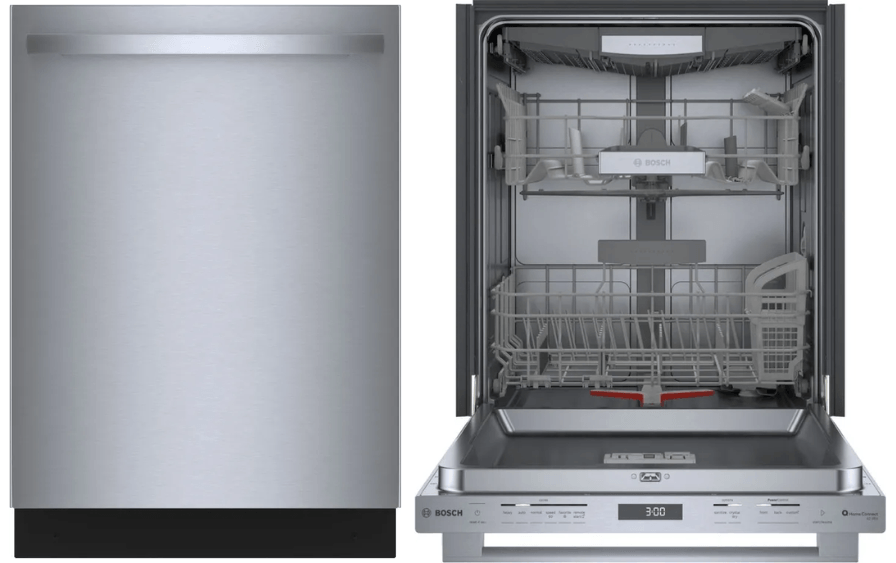
2) Bosch 800 vs. Miele G 5266 — Miele adds cycles; Bosch adds real tech
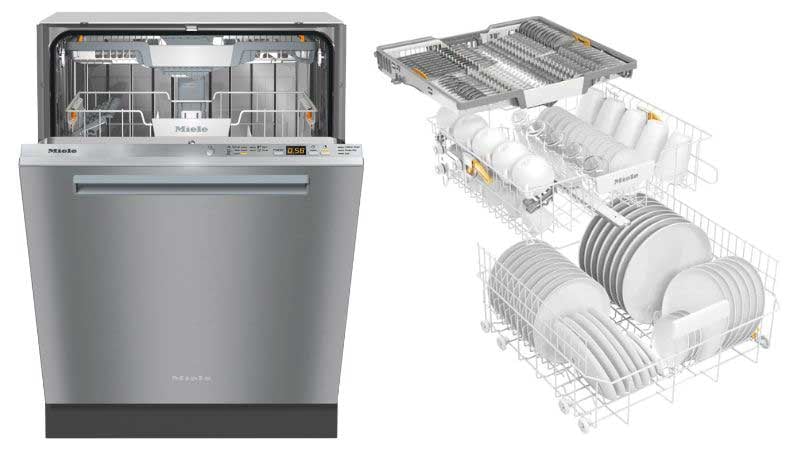
Drying
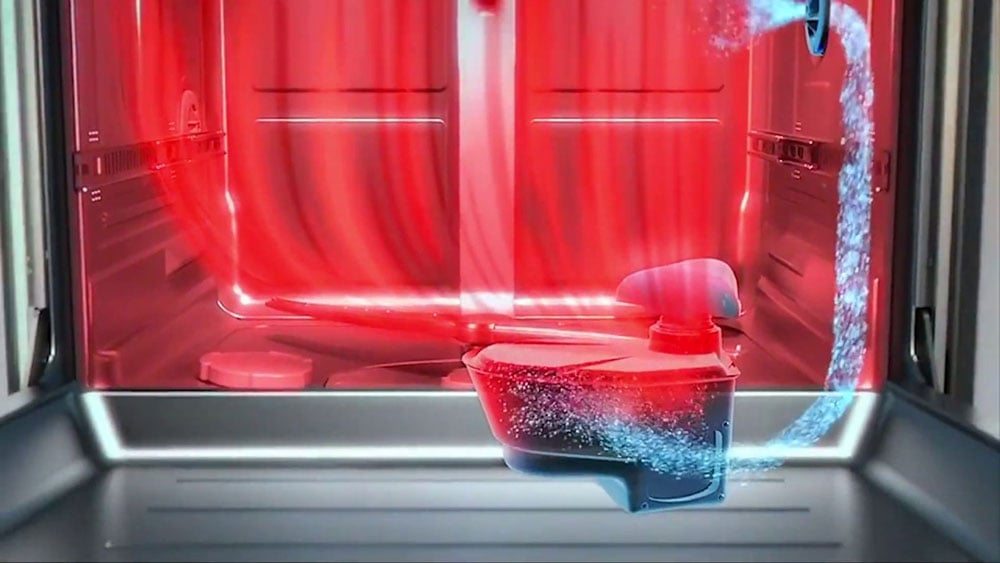
Bosch CrystalDry (zeolite) absorbs moisture and emits heat → raises temps and dries plastics best.
Washing Control
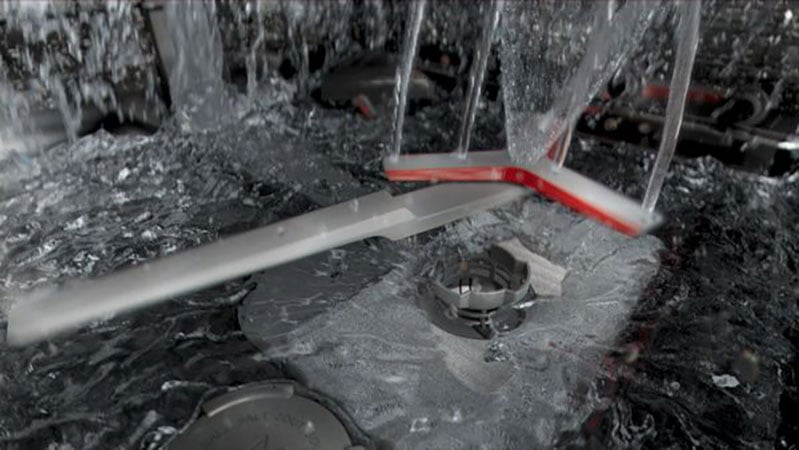
PowerControl lets you boost/soften spray in four bottom-rack zones. Load china and a baked lasagna pan in the same rack and tune each quadrant.
Miele’s Move At This Step
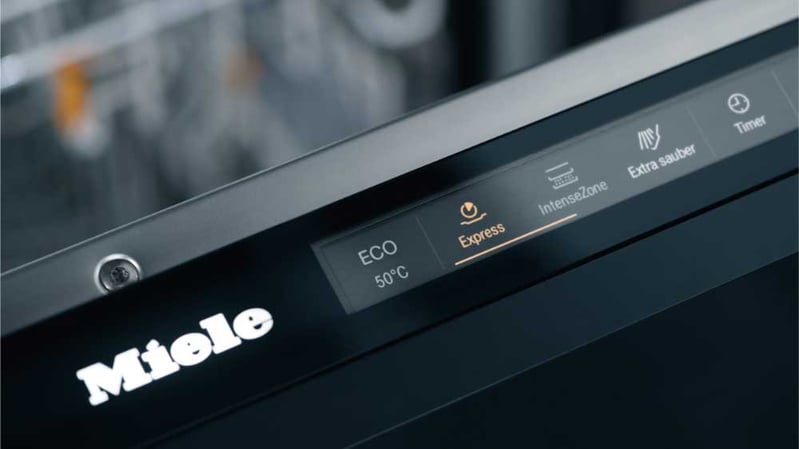
More cycles/options on a stronger version of the base platform (still excellent coverage from three full spray arms).
Net
Bosch 800 is the bigger jump in technology you feel nightly (plastic dry + zone control). Miele 5256 refines its base strengths (coverage, racks, added cycles).
3) Bosch Benchmark vs. Miele G 7156 — Bosch gets quieter; Miele adds dosing intelligence
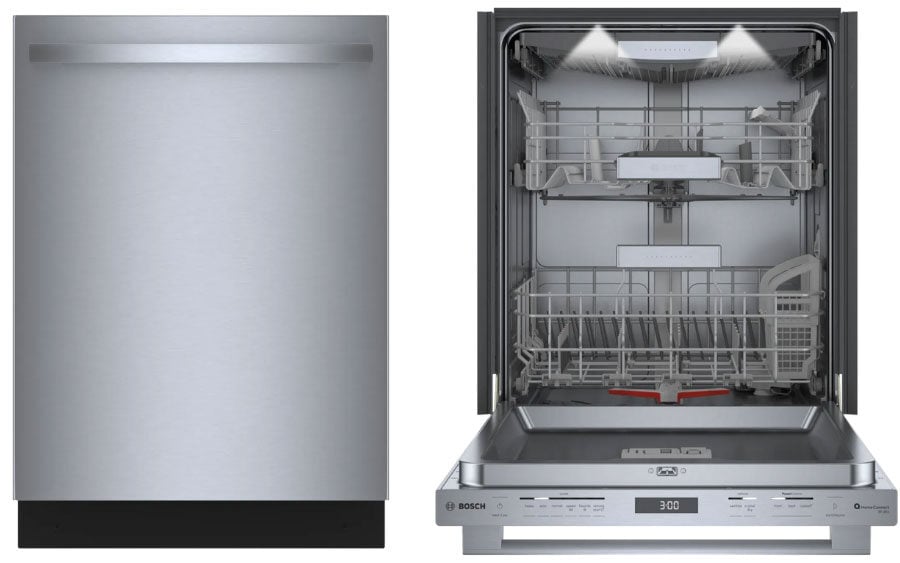
Bosch Benchmark
Quieter (down to 38 dB) and more cycles over the 800’s platform, while keeping CrystalDry and PowerControl.
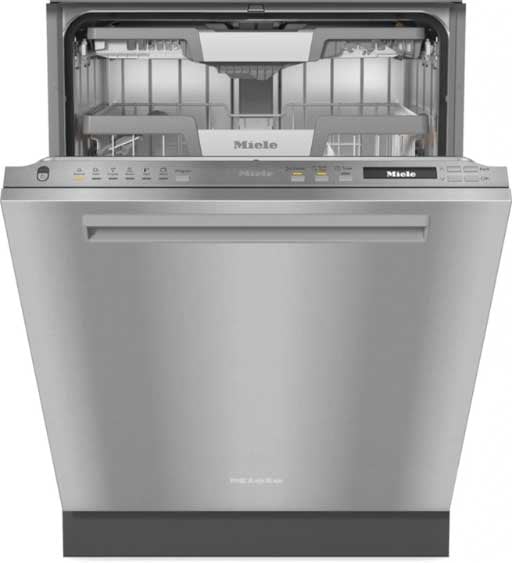
Miele G 7186
Adds AutoDos automatic detergent dispensing—right amount at the right time based on load/soil. That’s why glasses look clearer and re-washes drop.
Net
Top tier splits on what you value: Benchmark = ultra-quiet + CrystalDry; Miele G 7186 = wash consistency via AutoDos plus Miele’s superior rack adjustability.
Real Story: AutoDos vs. Pods
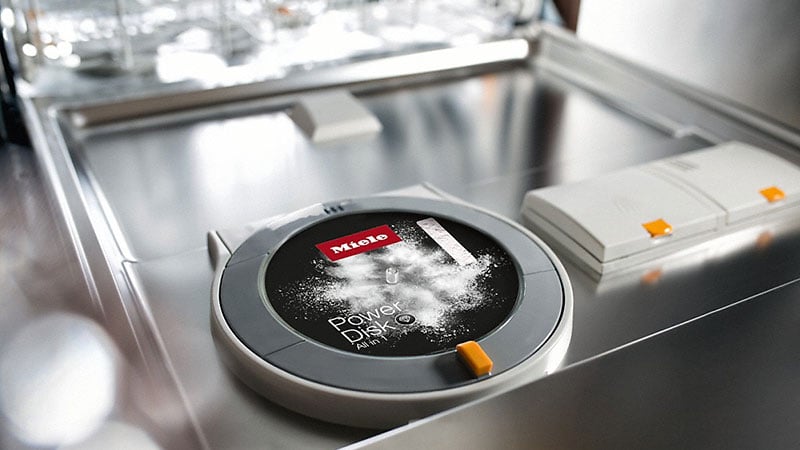
“The $1-load conversation.”
In the Miele showroom, I said what most people feel: AutoDos just works better because it dispenses the right amount of detergent at the right time.
We talked cost. AutoDos is just under $1 per load, and a pod is about 30¢. With pods, that thing opens, and that’s what you get.
Over time, too much detergent can etch nice glassware. AutoDos adjusts to soil level: sometimes more, sometimes less.
It’s a more expensive mousetrap, but it solves a real problem if you care about glasses.
| AutoDos (Miele) | Pod | |
| Typical Cost | ~$1.00 | ~$0.30 |
| Dosing | Variable, right-time/right amount | Higher (over-dosing risk) |
| Glassware Risk | Lower (less haze/etching) | Higher (over-dosing risk) |
| Outcome | More consistent clean, fewer rewashes | More polishing, occasional re-runs |
Racks & Loading (What Fits, What Stays Put)
Both brands have a third rack. They behave differently.
Miele
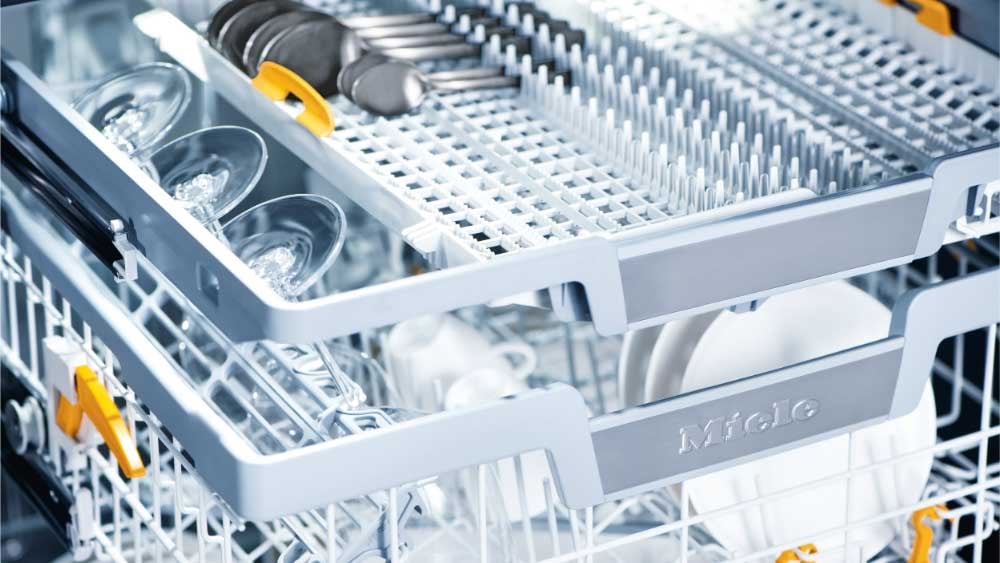
The 3D cutlery tray locks flatware so it doesn’t skate around; orange tabs mark fold-downs and movable sections; higher trims add more flexible tines and even slots that fit straws (including metal).
Great for stemware, fine silver, and odd-shaped bowls.
Bosch
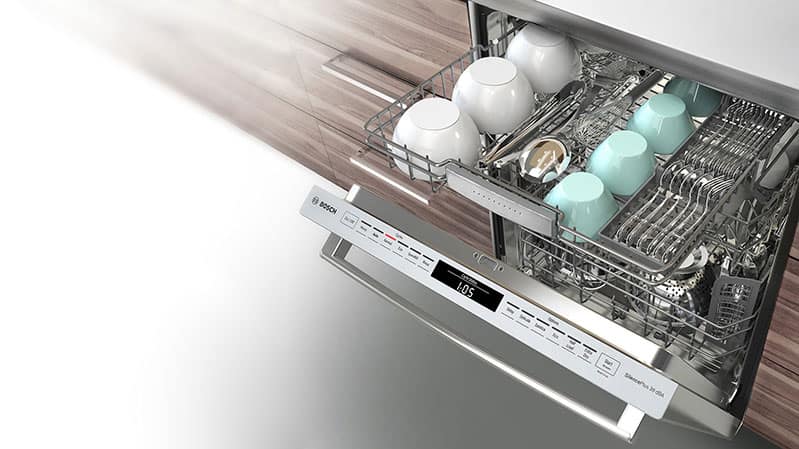
Bosch has a standard 3 rd rack in the 500 but a more flexible 3rd rack for utensils in the 800 and Benchmark series.
The Lower rack is forgiving for big plates and pans, with simpler adjustments than Miele’s top trims—easy to live with, fast to load.
What You Load vs. What Works Best
| Better Fit/Feel | |
| Fine stemware that clinks or chips | Miele (more precise geometry; fold-downs protect contact points) |
| Lots of flatware (want everything separated) | Miele (3D tray locks pieces; cleaner, drier) |
| Ladles, spatulas, small bowls on the third rack | Bosch (flexible 3rd rack) |
| Wide pasta bowls and roasting pans | Tie (Bosch is forgiving; Miele has more micro-adjustability) |
| Metal/plastic straws and small utensils | Miele (dedicated slots on higher trims) |
Service Is the Tie-Breaker
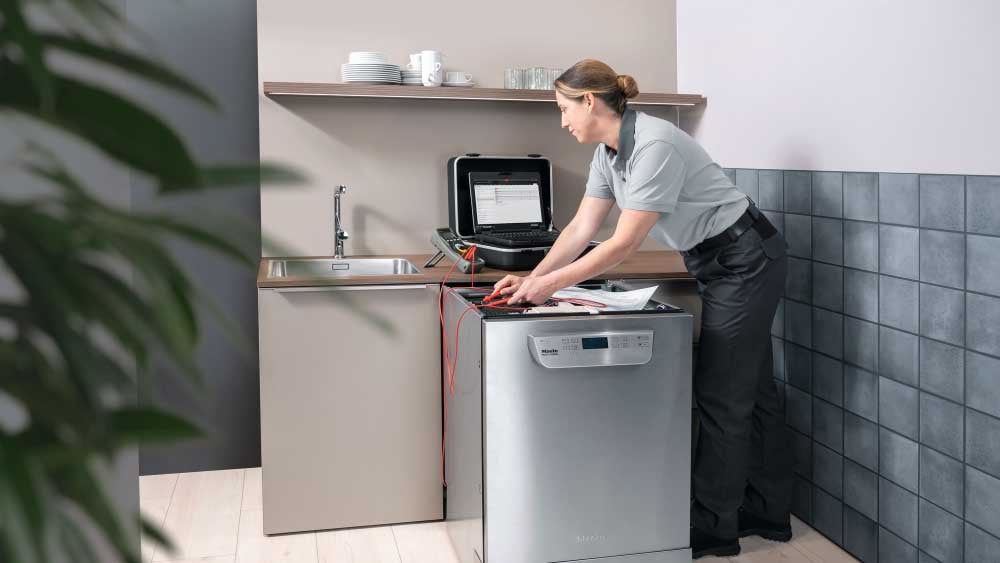
Even the best machines need a pump, valve, or board someday.
The real advantage is authorized local service and a correct installation.
Real Story: Nantucket Wait Times

Before we opened on Nantucket, the average service wait was 4–6 weeks for most appliances.
If you live on an island or anywhere that requires a ferry, the tie-breaker isn’t a spec. It’s who can fix it faster.
When something breaks, the brand with faster authorized service nearby wins.
Do this before you buy (5 minutes):
- Google “[Brand] service [Your Town]” and read recent reviews (last 6–12 months).
- Confirm it’s authorized service.
- Scan for response time, first-visit fix rate, and parts availability.
- Call one provider and ask their next available on your brand.
Bottom line: If one brand has stronger, faster service in your area, buy that brand.
What to Buy (Quick, Practical Picks)
- Best overall washer (least fuss): Miele G 7156 (or G 5256 to save). AutoDos + full-coverage spray = consistent results.
- Best plastics dryer: Bosch 800 or Benchmark with CrystalDry. If you pack lunch containers and lids, this is the one.
- Quiet + value: Bosch 500 (≤44 dB). You won’t hear it; you will like the price band.
- Fine stemware & silverware: Miele (3D cutlery tray; precise rack geometry).
- Mixed loads (china + baked pans, same rack): Bosch 800/Benchmark with PowerControl zones.
Additional Resources
Ready to find the best dishwasher? Join over 1 million readers of our acclaimed Dishwasher Buying Guide. Get detailed brand profiles, savvy buying strategies, and real reliability stats from 37,000+ service calls. Click here to make an informed decision and save money on your next dishwasher!
Related Articles:
Looking for answers about Dishwashers?
Choosing a new dishwasher can be a confusing and time-consuming experience. We've taken the pain out of the decision process with our Dishwasher Buying Guide.
Why Should You Trust Us?
It seems that every appliance review has nothing but glowing comments about almost every product, yet you read customer reviews and they are almost universally bad.
We are here to fill in the disconnect. We'll give you the best features, and the drawbacks as well, including reliability based on over 33,000 calls performed by our service team just last year. Our goal is to give you ALL the information so you know what's right for you.
Please consider subscribing or adding to the conversation in the comments below. We appreciate you stopping by.
A Note About Pricing
Pricing on this blog is for reference only and may include time sensitive rebates. We make every attempt to provide accurate pricing at time of publishing. Please call the stores for most accurate price.
Topics:
