

TL;DR: Recirculating Downdraft Vents: Why They Don’t Work and What to Do Instead
-
Avoid recirculating downdraft vents. They lack capture and airflow, then blow filtered air back into the kitchen.
-
Best fix: Use a real hood vented outside (bigger capture area, shorter duct run).
-
Best layout move: Put the cooktop on the wall and the sink on the island.
-
If you can’t vent outside (common in Boston / Back Bay): use a high-quality recirculating hood on a wall that discharges air higher, not at your feet.
If you’re planning a kitchen, avoid a recirculating downdraft vent.
It looks clean and “designer-friendly,” but it is one of the worst ventilation setups you can buy because it doesn’t capture cooking odors, grease, heat, and steam effectively.
In this article, I’ll explain why downdrafts struggle, why recirculating downdrafts are even worse, and what to do instead.
Let’s get started.
Recirculating Downdraft Vents: Why They Don’t Work and What to Do Instead
Do Downdraft Vents Work?
⚡ Quick Answer: Downdraft vents do not work well because they lack the capture area needed to vent odors, grease, heat, and steam, and gas cooking can add potentially harmful compounds to the air.
Downdrafts shouldn’t be on your list. They restrict airflow and don’t have the capture area you need.
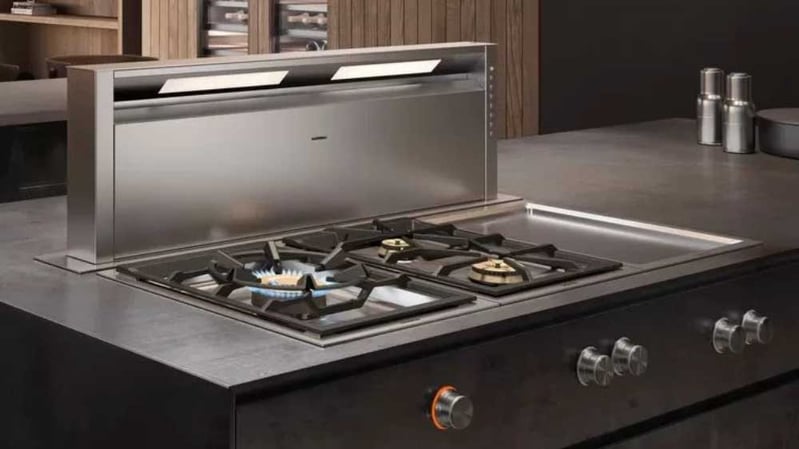
Cooking throws off heat, odors, grease, and steam. And with gas, you can also get potentially harmful compounds like nitrogen oxides, carbon dioxide, carbon monoxide, and formaldehyde.
Why Don’t Downdrafts Vent Odors, Grease, and Heat Effectively?
⚡ Quick Answer: Downdraft vents pull air through a small opening and a long duct run, which kills airflow and compromises venting, even when vented outside.
Downdrafts try to pull all of that through a small opening, then through a long duct run, usually with at least one elbow. And that kills airflow and effective venting.
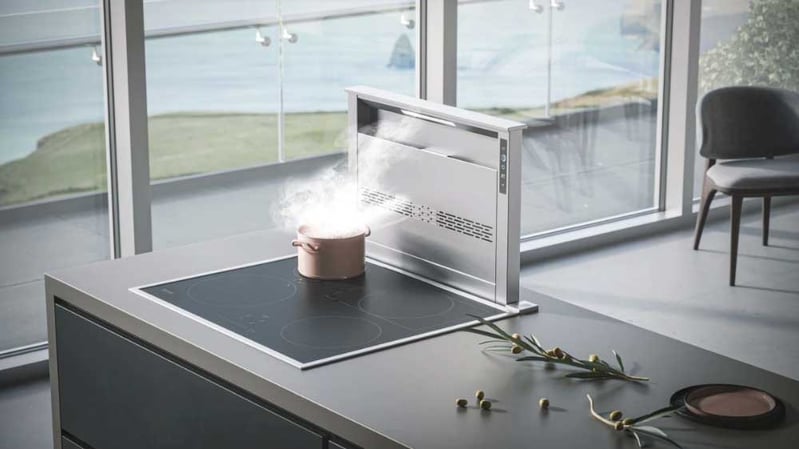
So even when they’re vented outside, they’re compromised. That’s bad enough.
🔍 Read more: The Ultimate Guide to Kitchen Ventilation
What Is a Recirculating Downdraft, and Why Is It So Bad?
⚡ Quick Answer: A recirculating downdraft pulls cooking air down through a charcoal filter and blows it back into the kitchen, spreading heat, odors, grease, and contaminants while costing $2,000 to $3,000 or more.
Let’s make a bad idea worse: combine a downdraft with recirculation, and nothing gets vented outside.

You’re pulling heat, odors, grease, and air and contaminants down, running it through a charcoal filter, and blowing that back into the kitchen.

And where does that usually come out? At your feet.
So instead of removing even some of the problem, you’re distributing it faster, along with the heat.
And you’re also spending $2,000 to $3,000 at least to circulate unhealthy air back into the space. You buy a perfectly good hood for less than that. So this makes absolutely no sense.
When Does a Downdraft Vent Make Sense?
⚡ Quick Answer: A downdraft can make sense if you are replacing an existing downdraft and do not want to remodel, but a downdraft with recirculation is still the worst of both worlds.
To be fair, there is one scenario where I understand a downdraft. If you’re replacing an existing downdraft and don’t want to remodel, I get that.

But combining downdraft and recirculation, that’s the worst of both worlds, and you can buy it from multiple manufacturers.
🔍 Read more: The 3 Most Powerful Downdrafts
How Do You Vent an Island Cooktop Properly Without a Downdraft?
⚡ Quick Answer: Vent properly with a hood that works, or avoid the island-venting trap by putting the sink on the island and the cooking surface on the back wall for a shorter, straighter duct run.
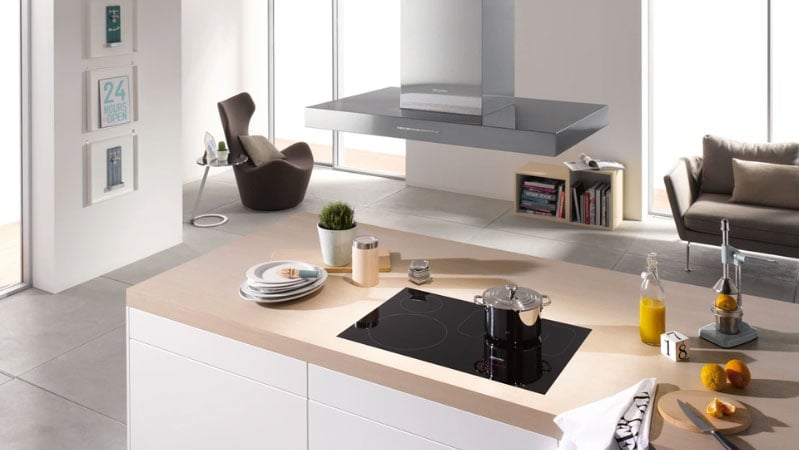
But here’s the real solution: vent properly. Almost all the time, this mistake happens on islands. People don’t want to see a hood. But there are good-looking island hoods that work.
However, an even better solution is to put the sink on the kitchen island with the cooking surface on the back wall. Now you can vent straight up or straight out. Short duct run, no elbows, better performance.
What If You Can’t Vent a Hood to the Outside?
⚡ Quick Answer: If you can’t vent outside, put the range on the wall and use a high-quality recirculating hood with better filtration that discharges air higher, not directly back where you’re breathing.
But even if you can’t truly vent to the outside, like in Boston, Back Bay, or historical homes, at least do this: put the range on the wall and use a high-quality recirculating hood with better filtration, which discharges the air higher, not directly back to where you’re breathing.

I still don’t love recirculating hoods, but it’s a far better option than blowing it back to your ankles at a higher price.

Final Takeaway: The Worst Appliance You Can Buy Is a Recirculating Downdraft
⚡ Quick Answer: A recirculating downdraft is the worst appliance you can buy because it fights physics, costs more than a proper vent, and actively makes your kitchen worse.
So that’s it. The worst appliance you can buy is a recirculating downdraft. It fights physics, costs more money than a proper vent, and it actively makes your kitchen worse.
And this is one of those things I usually recommend people go to a showroom, because one hour with somebody that knows venting will save you 20 hours of looking online.
And if you’re anywhere near Boston, you can see them in any of our six stores. Because venting is one of these appliances where you need to see your options. Click here to schedule your visit.
Additional Resources
Download the Yale Ventilation Buying Guide with features like ducting, the proper CFM for professional ranges, downdrafts, and much more. Over 1 million people have read a Yale Guide.
Related Articles

Why Should You Trust Us?
It seems that every appliance review has nothing but glowing comments about almost every product, yet you read customer reviews and they are almost universally bad.
We are here to fill in the disconnect. We'll give you the best features, and the drawbacks as well, including reliability based on over 33,000 calls performed by our service team just last year. Our goal is to give you ALL the information so you know what's right for you.
Please consider subscribing or adding to the conversation in the comments below. We appreciate you stopping by.