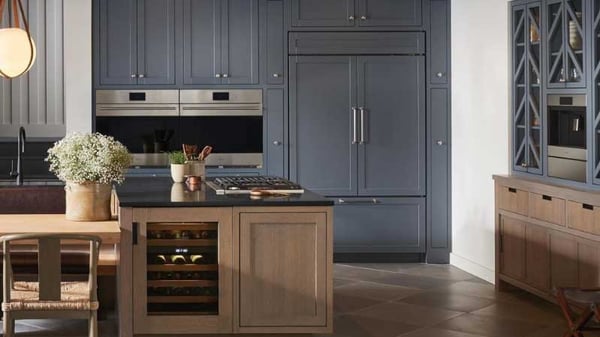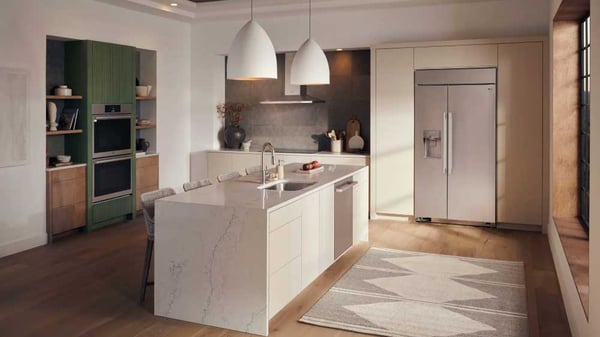

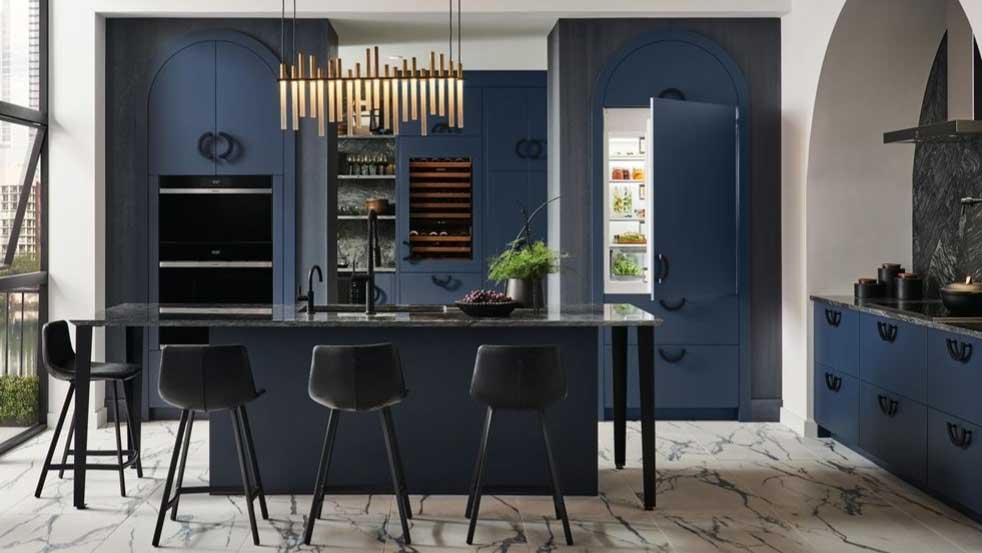
I should start by saying I own a Sub-Zero. It's in my kitchen at home and was in my previous home as well, so it's a good refrigerator because I live with it.
We've also sold and serviced Sub-Zero since before I was born, which was a while ago, in 1964. So I can tell you where it's good. I can also tell you where it falls short. I live with those tradeoffs every day.
A few years ago, I wrote that a Sub-Zero cost $12,000 to $20,000 and the wait ran over a year. During COVID, that wait improved.
The price did not. Sub-Zero has increased prices considerably since then.
Sub-Zero also doesn't own the market like it once did.
True, Thermador, Monogram, SKS, and Fisher & Paykel all make built-in refrigerators worth considering.
I'm not here to talk you into spending $15,000 to $20,000 on a refrigerator. Plenty of good refrigerators cost a fraction of that.
But if you're building your dream kitchen and choosing among appliances in that range, the question is which one earns the slot.
Is Sub-Zero still worth the money in 2026 and beyond?
📌 Skip Ahead
- Quick Verdict
-
Sub-Zero Classic vs. Designer vs. Pro: Which Build Is Right for You?
-
How Sub-Zero Compares to True, Thermador, SKS, Monogram, and Fisher & Paykel
-
Sub-Zero's Real Secret Weapon: Parts You Can Still Get in 40 Years
-
Sub-Zero and Built-In Refrigerator Installation: The Biggest Problem Nobody Warns You About
Is a Sub-Zero Refrigerator Worth It in 2026?
What Sub-Zero Has
- The most configurations in its class, available in stainless or fully panel-ready.
- A true commercial look with the Pro Series.
- Nanotechnology shelving that congeals spills so they pool instead of spreading.
- Vacuum-seal doors.
- Temperature control within about one degree.
- An air purifier that scrubs ethylene gas from the produce drawers.
- A combination of features built around one job: keeping food fresh longer.
What Sub-Zero Doesn't Have
- Custom color, while BlueStar and True build to order.
- In-fridge cameras, while Thermador and others let you see inside before you open the door.
- Stainless interiors across the line, limited here to the Pro Series.
- The interior capacity of certain brands like SKS.
- Flex drawers that convert refrigerator to freezer, which SKS and Thermador offer.
- Specialty ice, the slow-melting craft and diamond cubes, which SKS and Thermador offer.
Who Is Sub-Zero?
Sub-Zero is one of the last major appliance companies still owned by the family that started it.
Westye Bakke built his first refrigerator in 1945 to solve a problem at home. His son was diabetic, and the insulin had to stay cold.
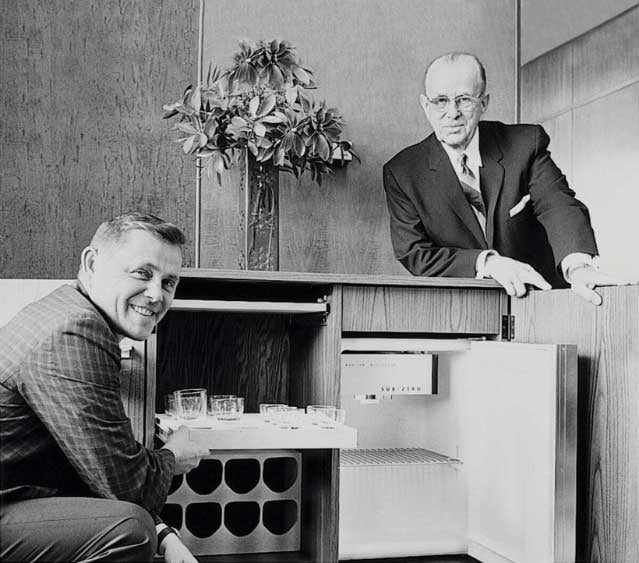
The company that grew out of that basement has built refrigeration ever since, and today the group also owns Wolf for cooking and Cove for dishwashers.
The focus shows up in the product. Sub-Zero's technology, while not as flashy as some of the brands you'll see later, is built to keep food fresher longer.
Every unit is run-tested before it leaves the factory, while most brands spot-check a few per batch.
What Makes Sub-Zero Worth the Premium?
The top of this article listed what Sub-Zero has. Here is why those features matter.
Sub-Zero invented the two-compressor system.
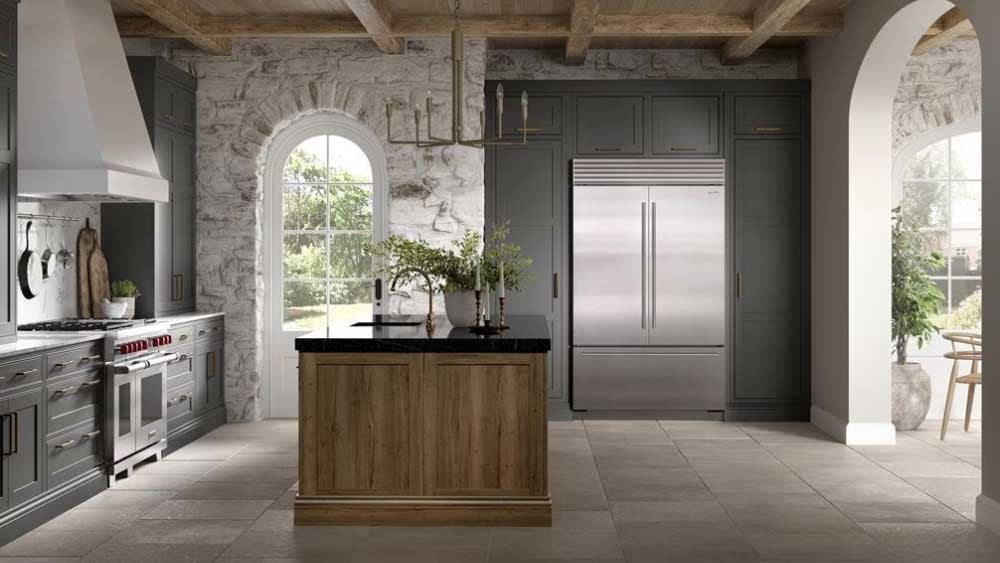
Most refrigerators run a single compressor for both the fridge and the freezer, which means the two spaces share air. Odors cross over. The freezer pulls moisture out of the fresh-food side.
Sub-Zero runs a separate compressor for each. The fridge stays cold and humid, the freezer stays dry and frigid, and the two never trade air.
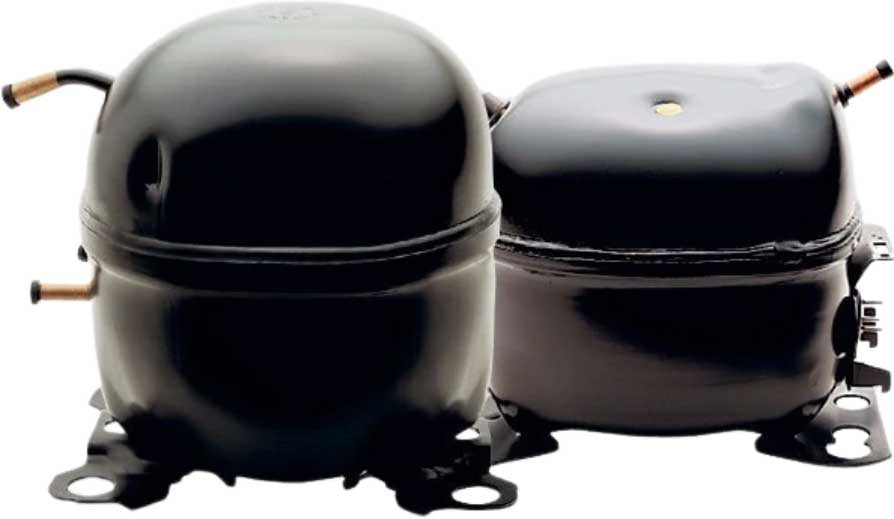
That separation was Sub-Zero's founding idea. Competitors have since copied it, but Sub-Zero got there first, and it is still the foundation the rest of the preservation system is built on.
How Sub-Zero Holds Temperature Within One Degree
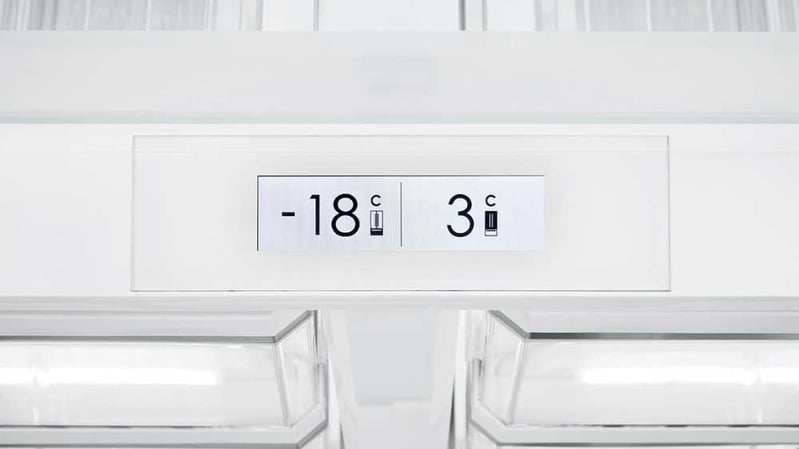
A sealed system, two fans, and a variable-speed compressor keep the temperature steady, instead of the 5 to 10 degree swings a standard refrigerator drifts through every cycle.
Steady cold is what slows spoilage. Every swing toward warm shortens the life of what's inside.
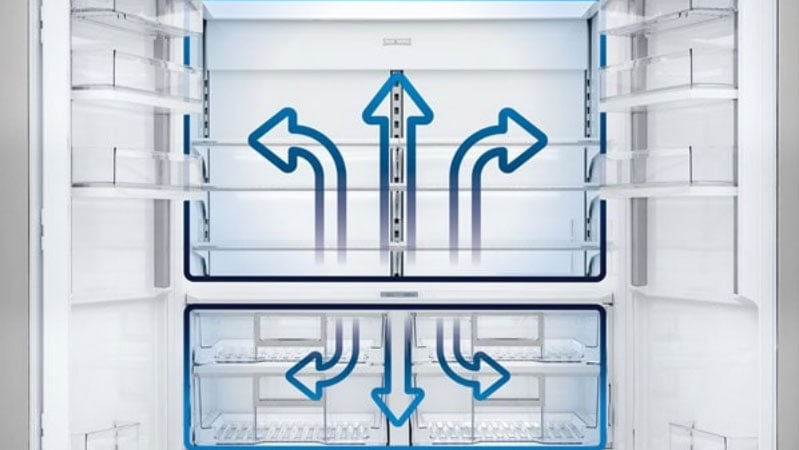
The newer Split Climate system sends air separately to the refrigerator and the freezer, so each side gets exactly the air it needs to keep food fresh.
How Sub-Zero's Air Purification Keeps Produce Fresh
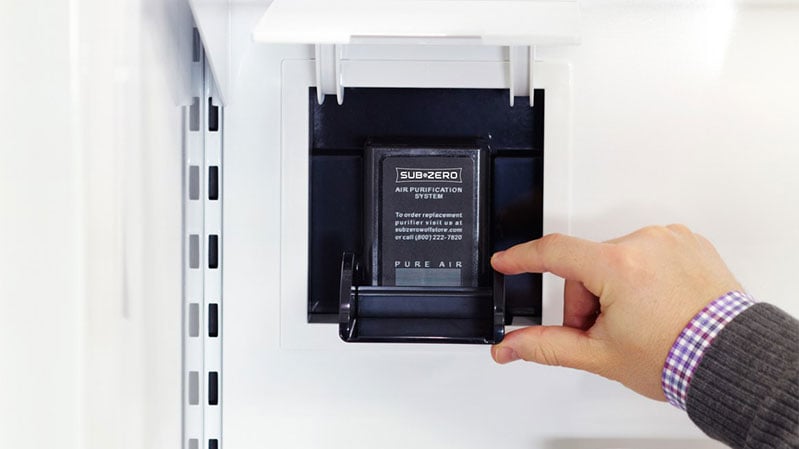
A scrubber pulls ethylene gas out of the fresh-food compartment.
Ethylene is the gas ripening produce gives off, and it's why one bad apple can ruin the whole drawer.
Less ethylene, slower ripening.
Why Sub-Zero Doors and Drawers Seal So Tightly
Open a Sub-Zero and you feel it. The door has a pull to it, almost a resistance, because the vacuum seal holds the cold air in and the room air out.
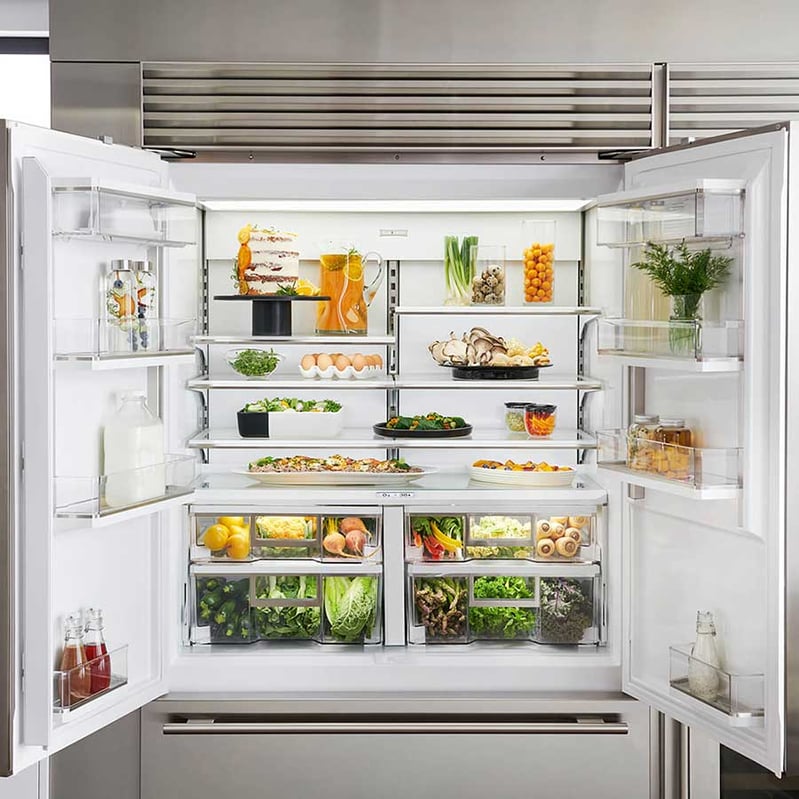
Less air trading places means less temperature swing inside.
The crisper drawers are magnetic, sealing tight to keep the fridge's air out and hold their own humidity steady.
What Is Sub-Zero's Nanotechnology Shelving?
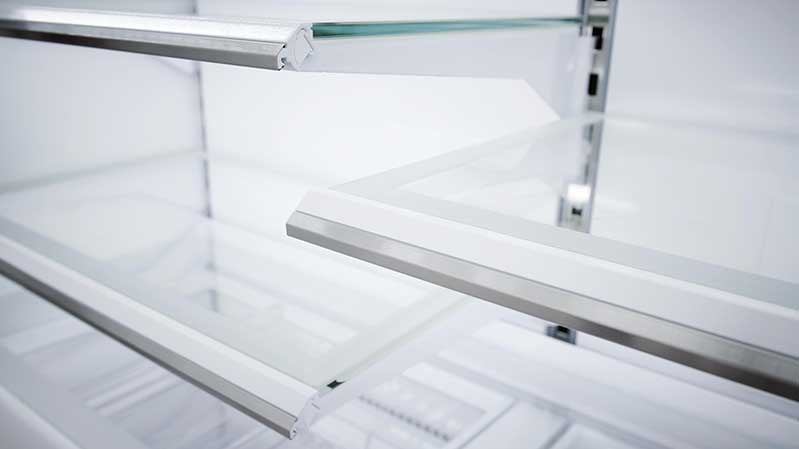
The shelves carry a coating that congeals spills instead of letting them run.
Liquid beads and pools where it lands. It doesn't sheet off the edge and down into the seams.
My daughter spills grape juice. With most refrigerators, that means cleaning sticky residue out of the door tracks and gaskets for weeks.
On Sub-Zero's shelves, it pools where it lands. You wipe it up and you're done.
The proof: Project Produce.
Yale ran the test in its own showroom. Identical produce, one standard refrigerator, one Sub-Zero, side by side.
Lettuce that wilted after seven days in the standard refrigerator stayed crisp for nearly four weeks in the Sub-Zero.

Sub-Zero Classic vs. Designer vs. Pro: Which Build Is Right for You?
Sub-Zero sells three full-size lines, and even people who shop the brand mix up the names. Here's the plain-English version.
Classic is the original built-in.
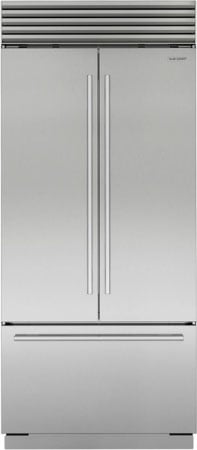
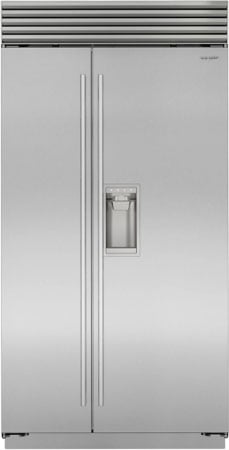
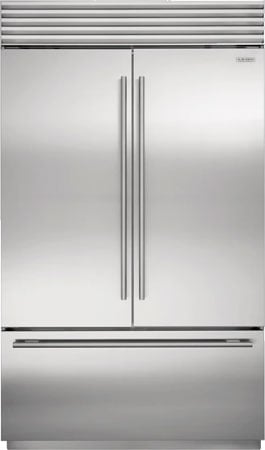
The compressor sits on top, behind the grille that reads as a Sub-Zero on sight. The cabinet is shallow but sits proud of your cabinetry by an inch or so.
It comes in stainless or panel-ready, in 30 to 48-inch widths, as a refrigerator, a freezer, French door, or side-by-side, with the option to add a water dispenser.
This is the one you're probably picturing when you think Sub-Zero.
It also runs about 10 percent more interior capacity than the Designer.
Designer is the fully integrated line.
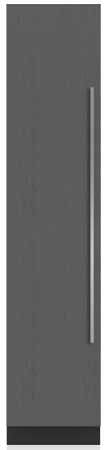
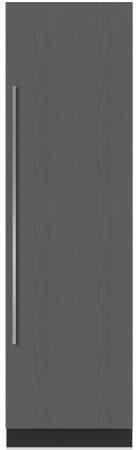
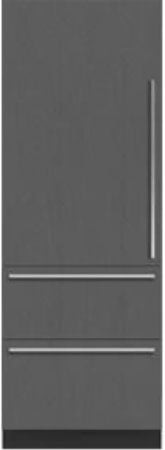
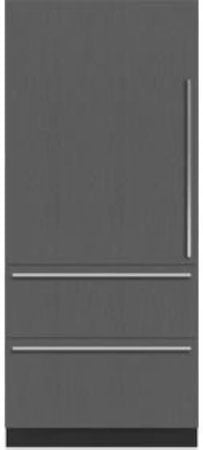
The compressors move to the bottom, so the unit sits flush with your cabinets and disappears into the kitchen.
I have the Designer in my own house, panel-ready. You cannot tell where the cabinet ends and the refrigerator begins.
You can also buy Designer as columns, 18 to 36 inches, in a range of configurations, so you can build the refrigeration around how you actually use it.
Pro is the commercial look.
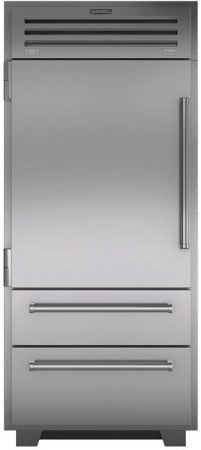
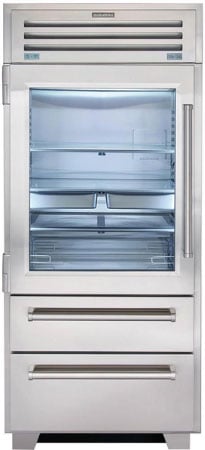
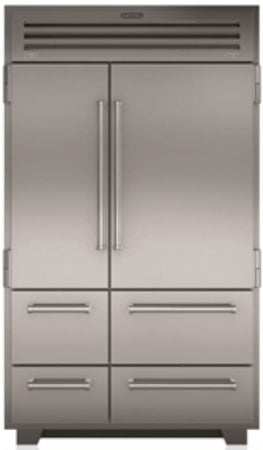
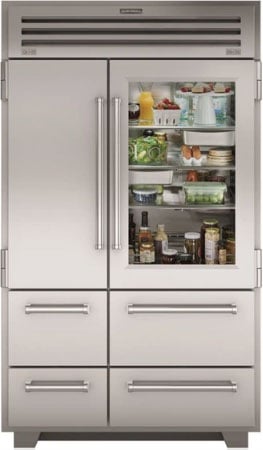
All stainless, exposed hinges, oversized handles, the restaurant aesthetic. It cannot be paneled.
Two Things Nobody Else Will Tell You
I know these because I own them.
You can make a Classic look like a Designer.
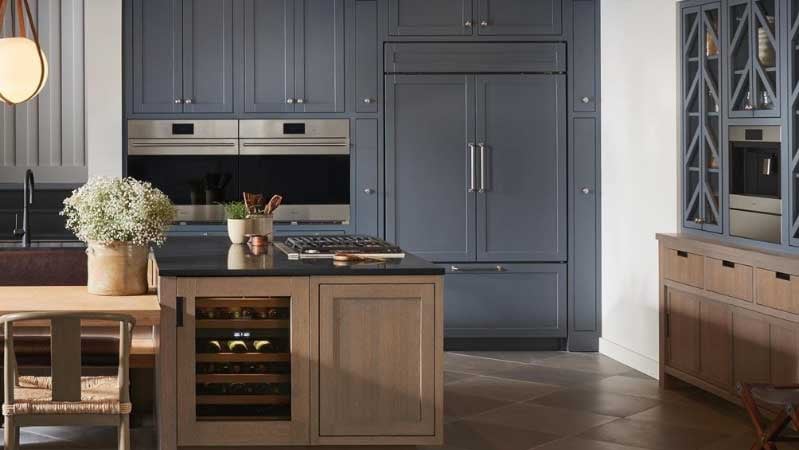
Say you want a 48-inch French door and you want it to read as seamless, flush with the cabinetry, the way a Designer does. You can bring the cabinets forward to close most of that gap and get much closer to the built-in, integrated look, without moving up to the Designer line.
On any bottom-compressor refrigerator, the top shelf goes high.
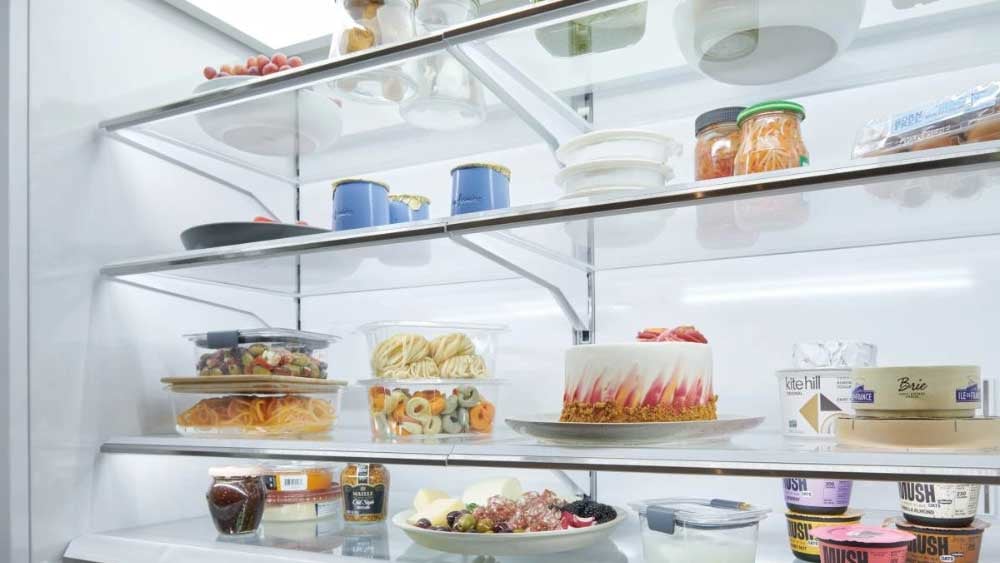
This is true of the Designer and of every integrated fridge with the compressor on the bottom, Sub-Zero or not. Moving the compressor down pushes the usable shelving up.
If you're under 5 feet 8, the top shelf may be a real reach. Stand in front of one before you buy.
See Sub-Zero Next to the Brands You're Cross-Shopping
If you're weighing Sub-Zero against True, Thermador, SKS, Monogram, BlueStar, or Fisher & Paykel, we show all of them in every Yale showroom.
Stand in front of them side by side, open the doors, and feel the difference before you commit to a cabinet drawing.
Boston, Framingham, Hanover, Norton, Hyannis, and Nantucket.

How Sub-Zero Compares to True, Thermador, SKS, Monogram, and Fisher & Paykel
Before the head-to-heads, one thing to set the table.
None of these brands match the configurations or the legacy of a Sub-Zero. Sub-Zero might give you 20 ways to build a 48-inch refrigerator. Most of these brands give you one or two.
So this is a long-term specialist against newer or more general competition. But one of them may have the single model that's right for your kitchen, and that's worth knowing too.
One difference that runs across several of them: True, Thermador, SKS, and Fisher & Paykel all give you stainless interiors, where Sub-Zero reserves that for the Pro Series.
Sub-Zero vs. True
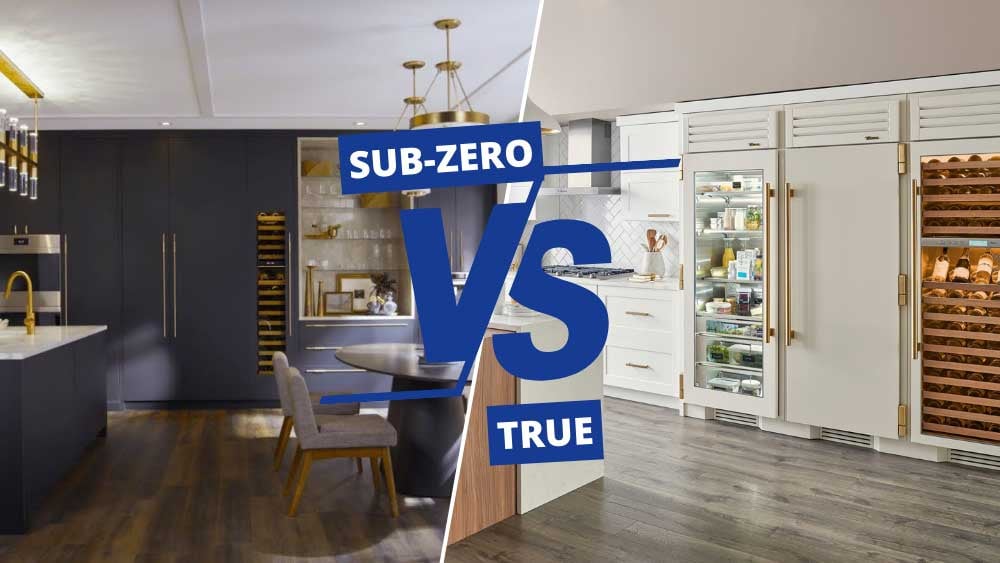
True builds commercial-style refrigerators only.
Of all these brands, it's the most like Sub-Zero in spirit, another family-owned American company.
But it's almost a different product. You get a true commercial look, plus 17 colors and a range of hinge options to make the refrigerator your own. That's customization Sub-Zero doesn't offer.
The catch is price. True runs more than a Sub-Zero.
And because it's built to be stainless or color, there are no panel options, so it won't disappear into your cabinetry.
True also has no integrated line to match the Sub-Zero Designer. Their beverage and wine columns, though, are worth a look.
🔍 Read more: Should You Buy a True Refrigerator for Your Home?
Sub-Zero vs. Thermador
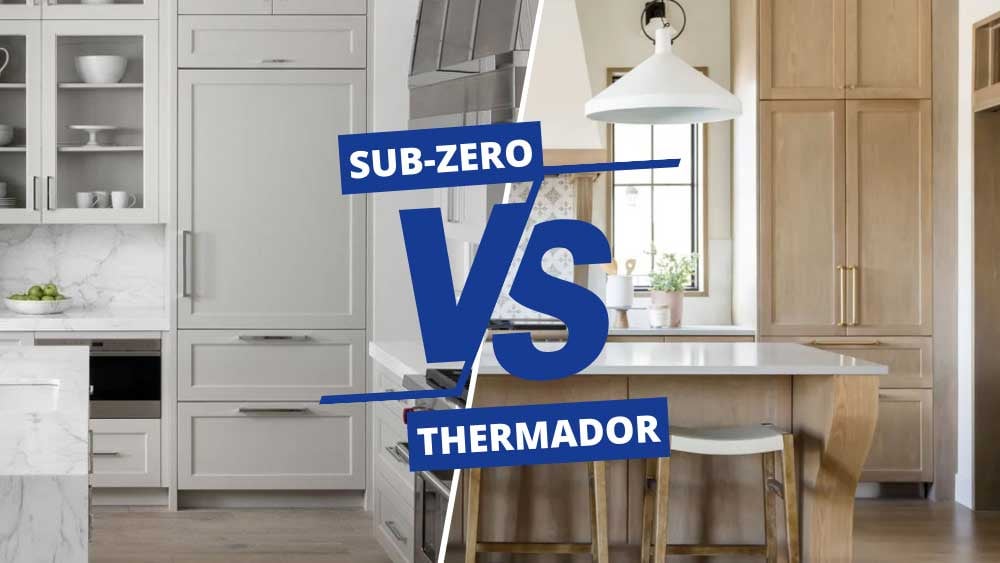
Thermador is the integration play, built to compete with Sub-Zero's built-in series.
They no longer make a top-compressor unit, so everything is the flush, bottom-compressor build now.
You get flush refrigeration in the larger 42 and 48-inch sizes, with smart features. You also get a flex drawer that switches between fridge and freezer, and dual ice: regular ice for everyday use, plus slower-dissolving diamond ice for cocktails, where you want to taste the drink and not the melt.
Both brands run package rebates. Thermador's 1-2-Free program gets you a free dishwasher and hood when you buy the package. Sub-Zero's gets you $1,000 off a Cove dishwasher when you buy with a Wolf product.
The catch is the reach. With the compressor on the bottom, you'd need to be about 6 foot 4 to reach the top shelf, and 6 foot 7 to reach the very top of the fridge.
🔍 Read more: Sub-Zero Classic vs. Thermador Freedom: 42- & 48-Inch Built-In Refrigerators Compared
Sub-Zero vs. SKS
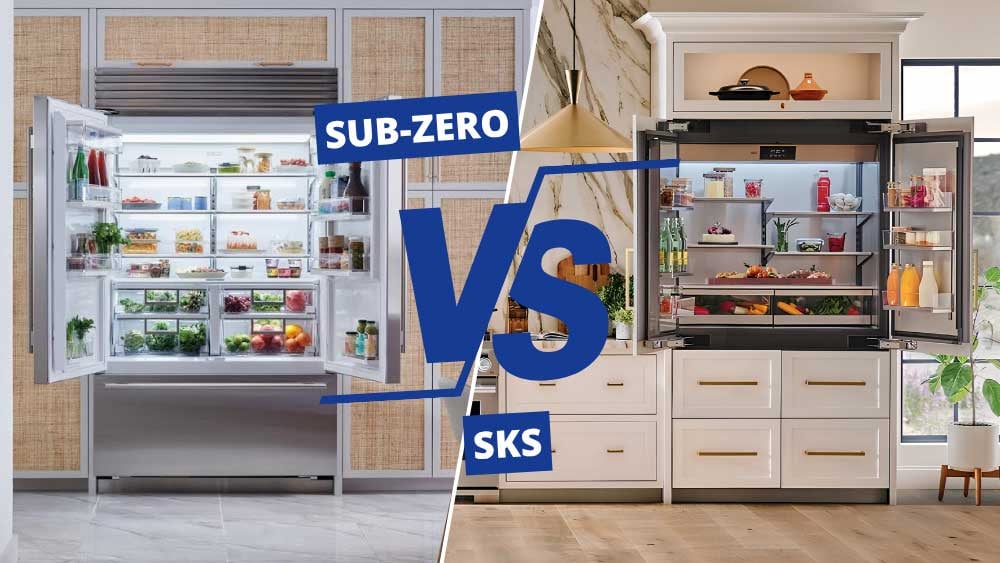
SKS (Signature Kitchen Suite) is a lot like Thermador. You get the 48-inch integrated plus 30 and 18-inch columns, and for an integrated line it gives you some of the most usable space a designer can work with.
The top shelf actually sits lower than Thermador's, about 6 foot 3 versus 6 foot 7, and there's no compressor pump-out eating into the box, so you get more usable capacity.
SKS also offers craft ice, the slow-melting spheres that hold up in a glass instead of watering down your drink.
The tradeoffs are configuration and shelving. You're choosing from far fewer builds than Sub-Zero offers, and SKS doesn't have the nanotechnology shelving.
It's a different refrigerator. But it's an up-and-coming brand worth watching.
🔍 Read more: Best 48-Inch Counter-Depth Refrigerators: Reviews, Installation Tips & Buying Guide
Sub-Zero vs. Monogram
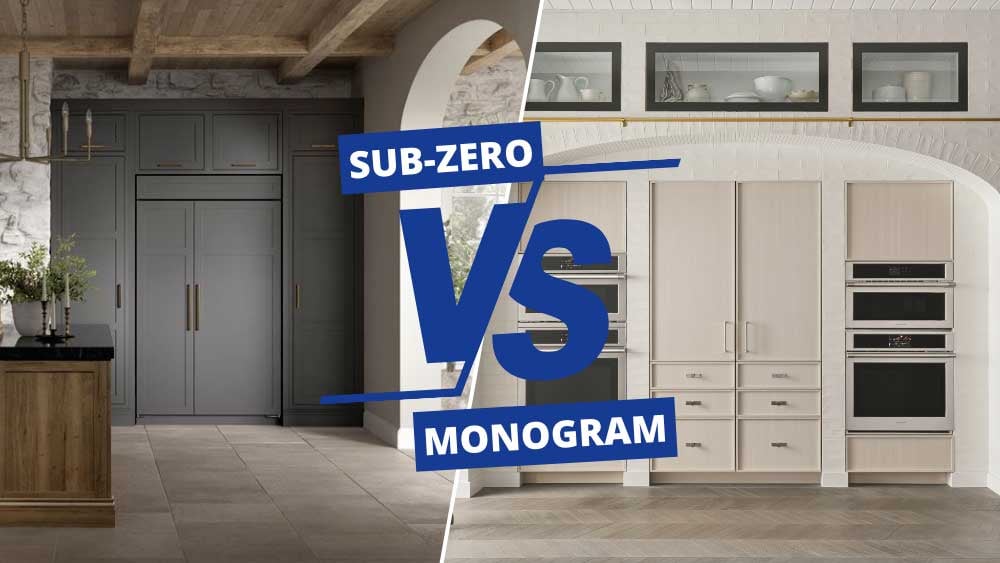
Monogram is an interesting refrigerator. Cold air comes out under each shelf to keep temperatures even top to bottom, and it offers quick-cool and quick-freeze shelving, handy when you want to chill a bottle of wine fast or freeze something in a hurry.
Monogram also runs a real rebate program, up to $3,000, or $4,500 if you add their hearth oven.
The catch is the compressor.
Monogram is a single-compressor refrigerator, which means air can move between the fridge and freezer instead of staying separated the way Sub-Zero's dual compressors keep it.
You get panel options, but not as many configurations as Sub-Zero.
🔍 Read more: Sub-Zero vs. Monogram Refrigerators: Which Is Better?
Sub-Zero vs. BlueStar
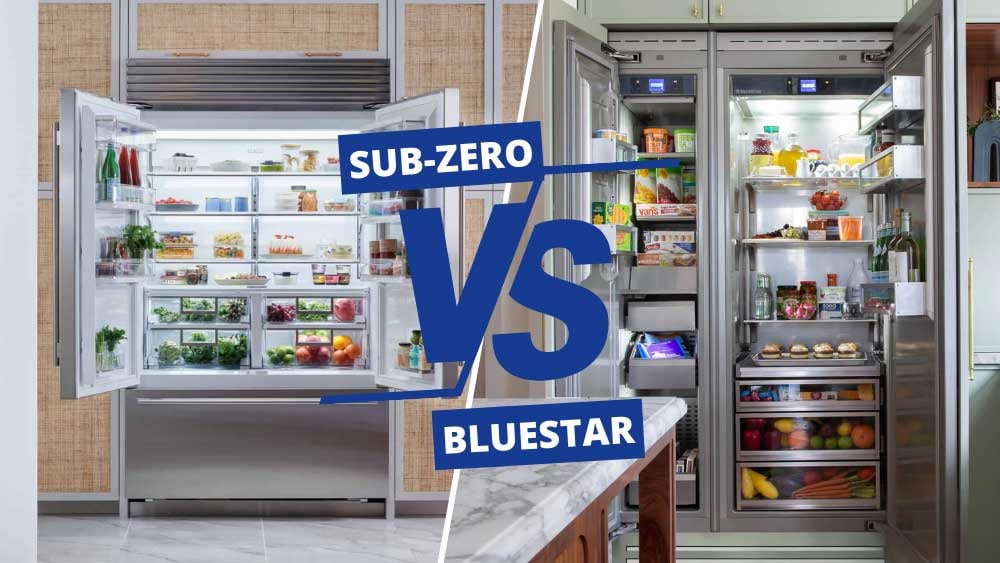
BlueStar is the fun one. All stainless inside, over 1,000 colors and six trim options outside.
You can match it to the rest of your BlueStar kitchen.
BlueStar also sizes the interior to fit a square chef's pan, which is a nice touch if you happen to cook with one.
The tradeoffs are the familiar ones.
BlueStar can't be paneled into your cabinets, and it doesn't have the refrigerator configurations or the nanotechnology shelving of a Sub-Zero.
🔍 Read more: 6 Trending Luxury Appliance Brands You Should Know
Sub-Zero vs. Fisher & Paykel
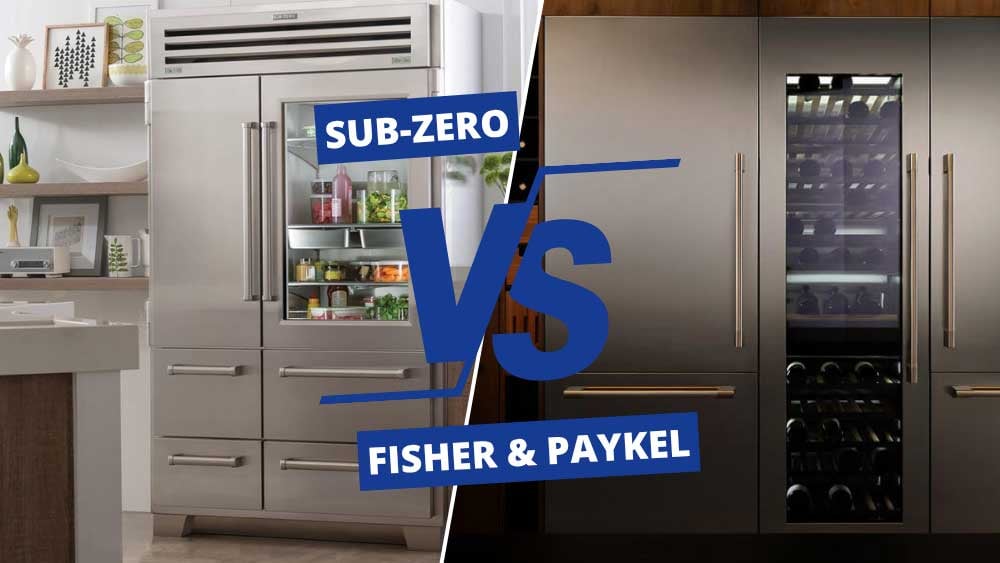
Fisher & Paykel makes decent integrated refrigeration. But the reason it's on this list is one specific model: a dual-compressor bottom-freezer refrigerator that runs about $7,000 less than the comparable Sub-Zero.
That's a real value play.
Two compressors, the thing that matters most for preservation, at a meaningfully lower price.
The tradeoff is everything around it. You don't get the configurations, the panel range, or the features that make a Sub-Zero a Sub-Zero.
🔍 Read more: Best Integrated Refrigerators: Top Brands, Features & Buying Guide
Sub-Zero's Real Secret Weapon: Parts You Can Still Get in 40 Years
Sub-Zero's warranty is the best in the industry. Five years full, twelve years on the sealed system. Other premium brands have good warranties too, so on paper that's an edge, not a chasm.
The real difference is the part nobody tells you about, because almost nobody fixes anything anymore.
Sub-Zero still stocks parts for nearly everything they've ever built.
We can get parts for units that predate my time at Yale, and I started in 1986.
That's 40 years of refrigerators still serviceable.
That's why Sub-Zero is our service department's favorite appliance to work on. The parts are there.
Here's what that means for you.
You will never get the call that a built-in refrigerator is a total loss because the parts no longer exist, and that the only fix is $20,000 for a new one.
On a Sub-Zero, it doesn't happen.
Does a Sub-Zero Add Resale Value?
A friend of mine was in the lighting business. We bought from him for years, and he filled his own house with designer lighting, the good stuff.
When he went to sell, he was walking buyers through all of it, showing off the fixtures. The realtor pulled him aside and told him straight:
"The Sub-Zero and Wolf will help sell this place. Nobody's asking about the lighting."
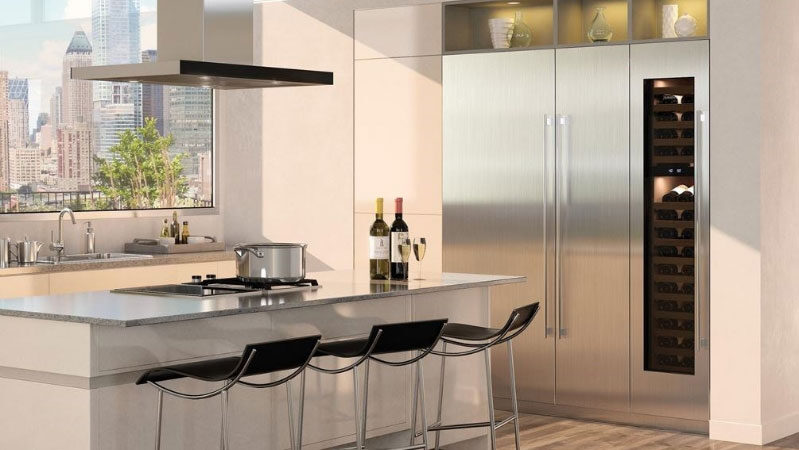
The guy who sold lighting for a living, and the kitchen was the selling point.
Just recently, a friend who'd spent years as a realtor turned developer and built a custom house in Newton. He insisted on Sub-Zero, because he knew from listing homes what a Sub-Zero and Wolf kitchen does to a buyer.
The other premium brands carry some of this now.
But open the real estate listings and look at the better homes. You'll still see Sub-Zero and Wolf kitchens named, again and again.
Sub-Zero and Built-In Refrigerator Installation: The Biggest Problem Nobody Warns You About
You'd think hanging a panel on a refrigerator would be simple. Frame it, mount it, done, like hanging a picture.
It isn't.
Panel installation is the single biggest callback in our industry, on every built-in brand, not just Sub-Zero.
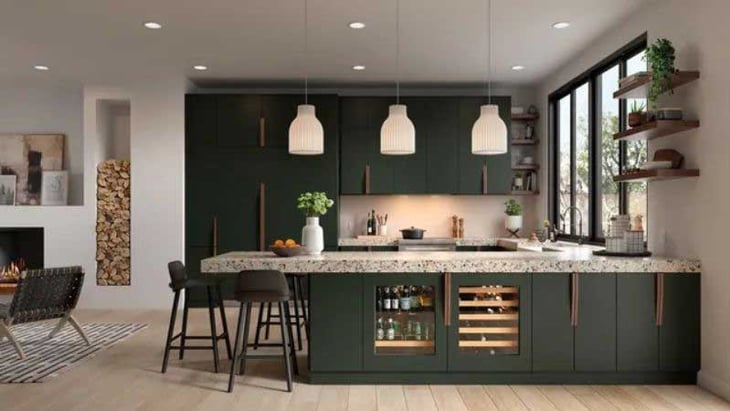
The panels are heavy, the tolerances are tight, and a fraction of an inch off shows.
So whatever built-in you buy, price out the installation before you sign.
The typical charge runs around $500.
We have 18 installation teams, and built-in panel work is something we specialize in.
We charge $99.
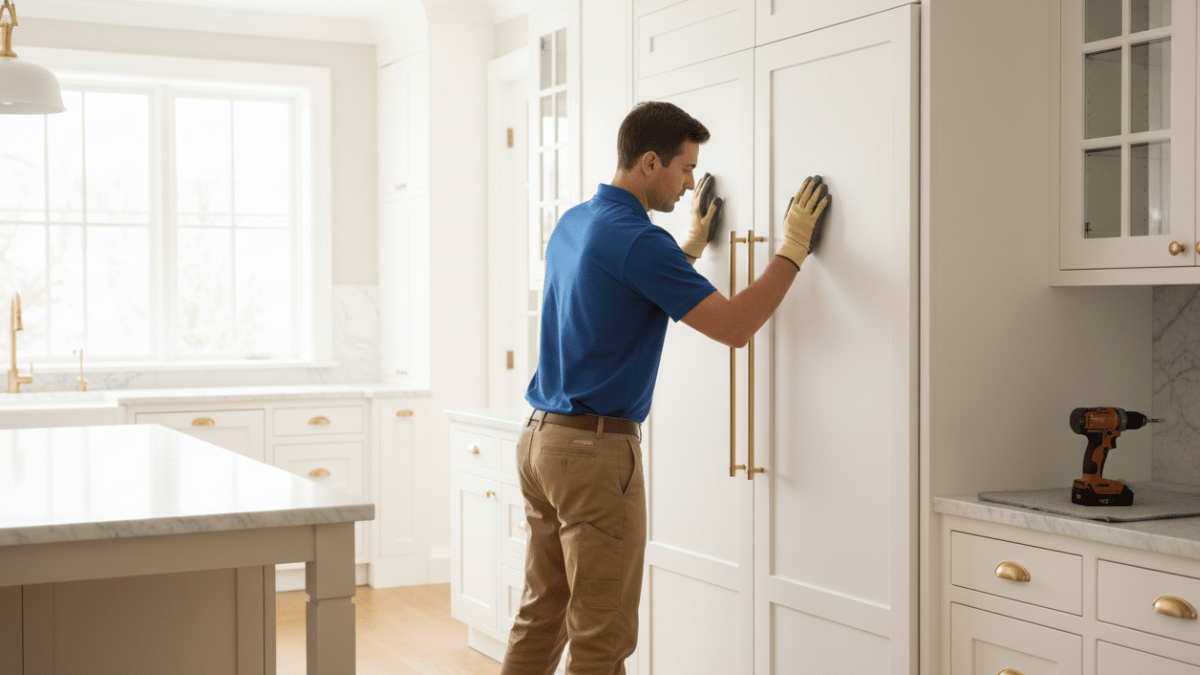
Part of the reason is that we end up fixing botched installs for free anyway.
We'd rather get credit for doing it well and inexpensively than get called in after someone's already angry.
If you're buying any built-in refrigerator, this is the line item nobody warns you about. Now you know to ask.
Should You Buy a Sub-Zero Refrigerator?
This article was never about getting you to spend $20,000. There are plenty of good counter-depth refrigerators in the $2,000 to $5,000 range, and for a lot of kitchens, that's the right call.
But Sub-Zero looks right in a custom kitchen, it customizes to the room, and it keeps food fresher longer.

So should you buy one? You should consider it. Just know that
Sub-Zero doesn't own the built-in category the way it once did.
True, Thermador, SKS, Monogram, BlueStar, and Fisher & Paykel all earn a look.
See Them Side by Side Before You Decide
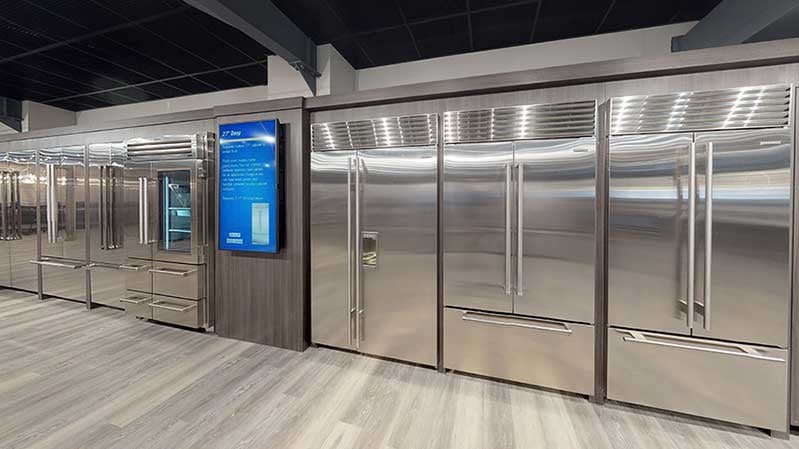
The best way to choose a built-in refrigerator is to stand in front of them.
We show Sub-Zero next to True, Thermador, SKS, Monogram, BlueStar, and Fisher & Paykel in every Yale showroom, so you can open the doors, pull the drawers, and see the difference for yourself.
Visit us in Boston, Framingham, Hanover, Norton, Hyannis, or Nantucket. Bring your kitchen plans.
When you buy from us, we deliver and install it, panels and all, for $99. And we service what we sell.
These are the questions I hear most often, in the showroom and a year or two after the refrigerator is in the kitchen. The answers are short.
Additional Resources
Get the Yale Counter-Depth Refrigerator Buying Guide to see what counter-depth costs you in storage, and which models give it back. Over 1 million people have read a Yale guide.
Related Articles:

Why Should You Trust Us?
It seems that every appliance review has nothing but glowing comments about almost every product, yet you read customer reviews and they are almost universally bad.
We are here to fill in the disconnect. We'll give you the best features, and the drawbacks as well, including reliability based on over 33,000 calls performed by our service team just last year. Our goal is to give you ALL the information so you know what's right for you.
Please consider subscribing or adding to the conversation in the comments below. We appreciate you stopping by.