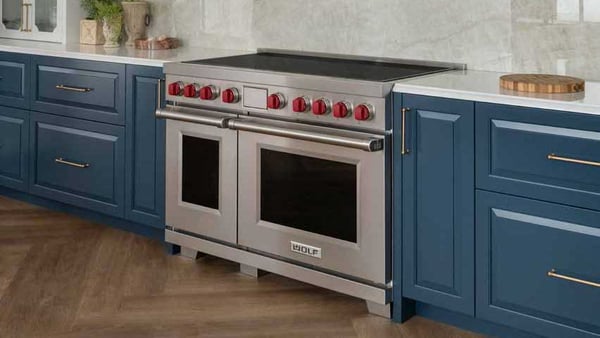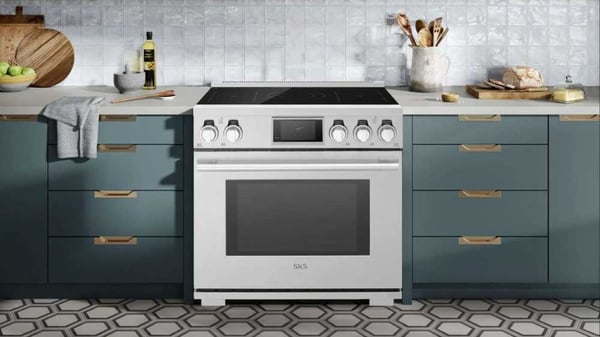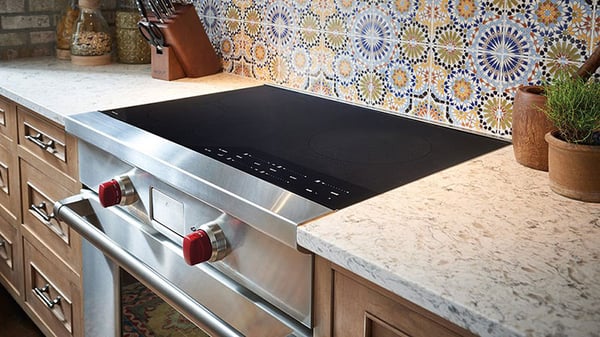

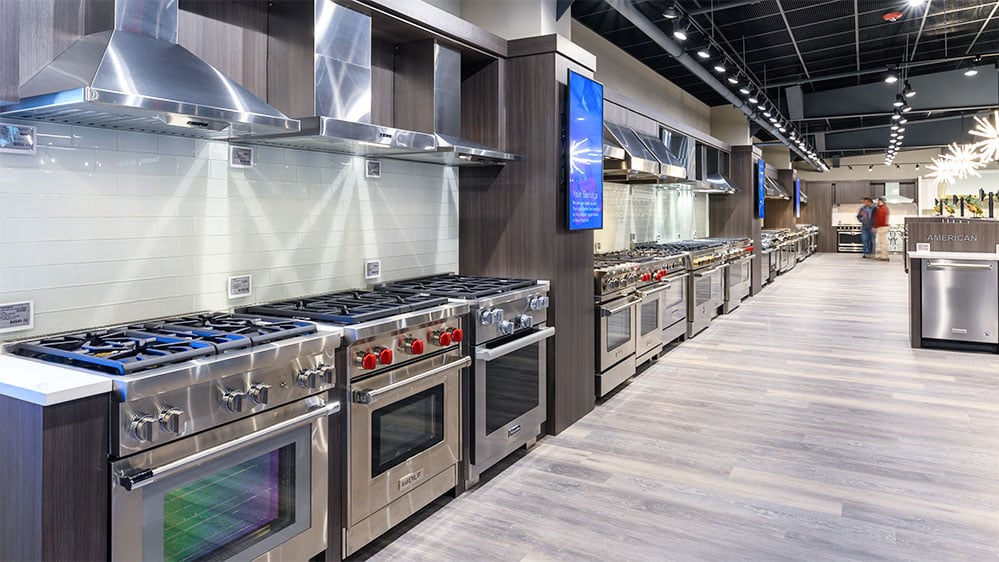
For the last 30 years, a dual fuel range has been the standard in a luxury kitchen. You get the speed of gas on top and the consistency of an electric oven underneath.
Over the last three years, induction has taken that argument apart. The output is better, and the selection from Wolf, Miele, and SKS has evolved.
So should you still buy dual fuel? The answer depends on the size of the range and on how you cook.
We sell and service all three technologies across Massachusetts, Rhode Island, and southern New Hampshire, and we logged 33,190 service calls last year.
Here is what you will learn:
- What each technology needs electrically before you spend a dollar on the range
- How much induction has actually improved, with the boil times to prove it
- The four places gas still beats induction outright
- Why 30 inches and 48 inches give you completely different answers
In this article
- Dual Fuel vs. Induction: The Quick Comparison
- Do Induction and Dual Fuel Need the Same Electrical Service?
- How Much Has Induction Improved in the Last Two Years?
- Where Does Gas/Dual Fuel Still Beat Induction?
- Does Range Size Change the Dual Fuel vs. Induction Answer?
- So Should You Buy a Dual Fuel Range or an Induction Range?
- What Do Buyers Get Wrong About Dual Fuel and Induction?
- Related Resources
- The Bottom Line: Dual Fuel Still Wins Above 30 Inches
- Frequently Asked Questions
Dual Fuel vs. Induction Ranges 2026: The Quick Comparison
Induction wins on the burner. Dual fuel wins on configuration once you move past 30 inches.
Do Induction and Dual Fuel Need the Same Electrical Service?
One thing is worth knowing before anything else, because it decides what is even possible in your kitchen.
Induction and dual fuel both require a dedicated 240-volt electric line. Dual fuel needs it for the electric oven. Induction needs it for everything.
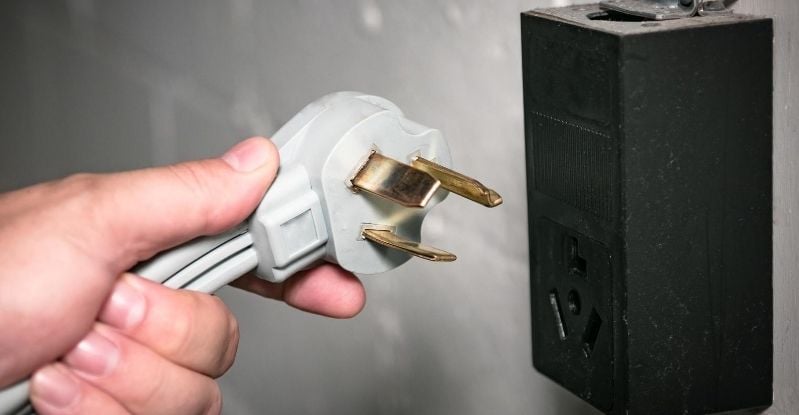
A straight all-gas range is the outlier. It runs on a regular 120-volt outlet, drawing about 12 amps, which is the same plug your old range is already using.
That means the dual fuel versus induction decision does not save you the electrical work. If you are switching from all-gas, you are calling an electrician either way.
Our guide to converting a gas range to induction walks through what that involves.
How Much Has Induction Improved in the Last Two Years?
Before we talk about what dual fuel still does better, you have to understand what happened to induction.
Induction was always the faster burner with the better simmer.
It also needs less venting, because it does not throw heat the way a gas burner does.
That also makes it safer around kids and aging parents, since nothing heats up unless a magnetic pan is on it.
How Many Watts Does a Modern Induction Element Put Out?
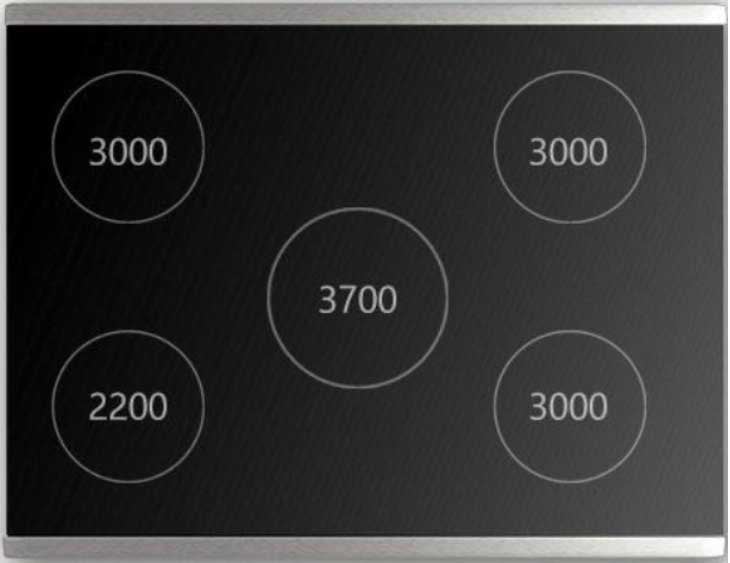
What changed is raw output.
For years the ceiling on a standard induction element was about 3,700 watts, and that already outperformed most gas burners.
Today the top elements run 7,000 watts and higher.
How Fast Does Induction Boil Water Compared to Gas?
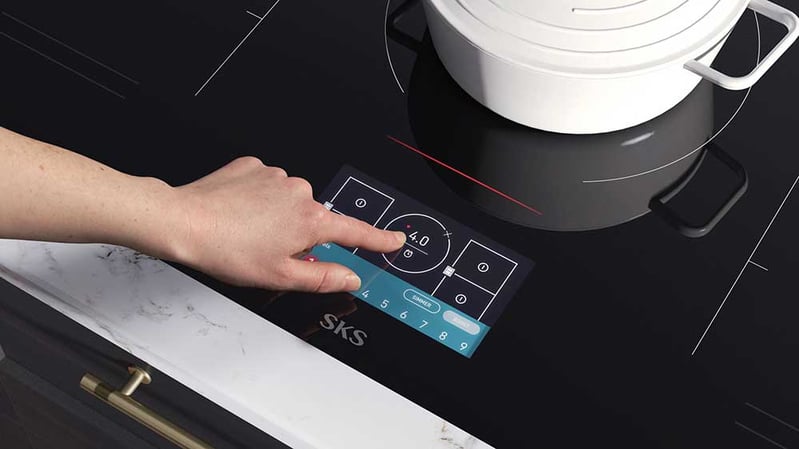
We boiled a gallon of water in 3 minutes and 27 seconds on a 7,000-watt induction element.
The same gallon took 13 minutes and 30 seconds on a 23,000 BTU pro gas burner.
That is close to four times faster, against one of the most powerful gas burners on the market.
Induction is the better burner now, and that is not really in dispute.
But gas still has its advantages.
🔍 Read more: The 3 Fastest Induction Cooktops
Where Does Gas/Dual Fuel Still Beat Induction?
You Keep the Cookware You Already Own
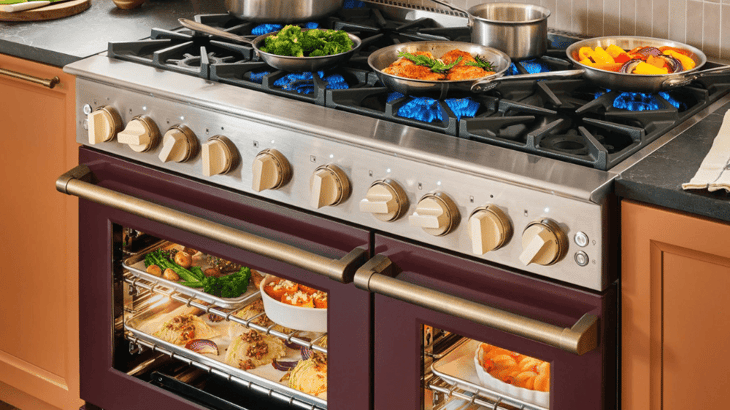
With gas, nothing in your cabinets becomes obsolete. Copper, ceramic, aluminum, and any non-magnetic metal all work exactly as they do now.
Induction needs a magnetic pan to do anything at all.
If you are a serious cook with a real collection, that is a real cost to replace all that cookware.
Gas Still Works in a Power Outage
If you live somewhere that loses power, this matters. You can light a gas burner with a match and keep cooking.
An induction range is fully electric, so it goes down with the house.
I have lived in Boston since 2004. Power has gone out twice in that time, so it is not much of a consideration.
On the Cape and the Islands, it is worth considering.
You Can Char Directly Over a Flame
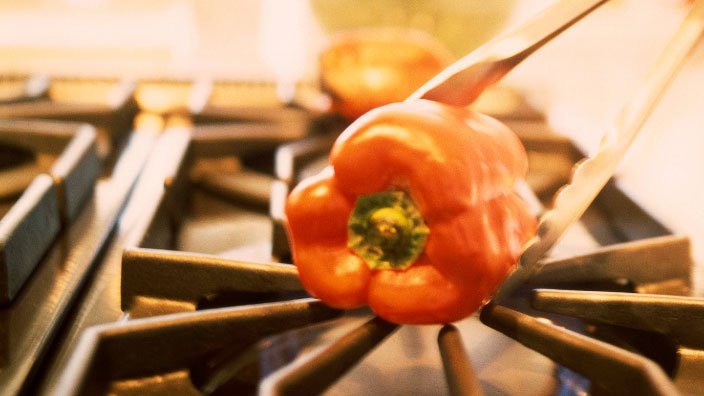
You can blister a pepper over a gas burner. You cannot do that on induction, because there is no flame and the glass only heats the pan.
I have had that comment on YouTube more than once.
If it matters to you, stay with gas.
Gas Burners Are Easier and Cheaper to Fix
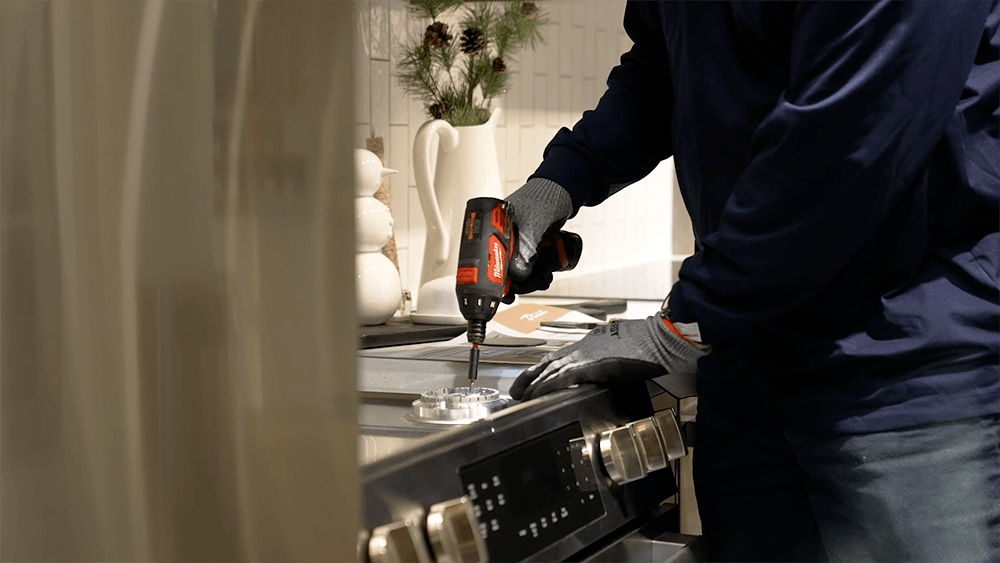
An igniter on a gas burner is a simple part to replace. An induction element is far more complicated, and fewer technicians are qualified to work on one.
The service numbers point the same direction. Out of the 33,190 service calls we logged last year, gas ranges came back for service 6.9% of the time in the first year. Induction ranges ran 8.7%.
Induction Range Reliability for 2026
These are the first-year service rates on every induction range we sold and serviced. Each brand cleared a 50-unit minimum, from a sample of more than 1,000 units.
Gas Range Reliability for 2026
These are the first-year service rates on every gas range we sold and serviced. Each brand cleared a 100-unit minimum, from a sample of more than 900 units.
Both sit near or below our 8.3% average across every appliance we sell, so neither is a problem category.
But there is more to go wrong on induction, and the data says so.
One caveat we want to be straight about. Both of those rates come from our mass-market brands, because the pro lines do not sell in the volume it takes to publish a rate we can stand behind.
The direction holds. The exact numbers do not transfer to a Wolf or a Thermador.
If reliability is driving your decision, start with the most reliable induction ranges and the most reliable gas ranges. The spread between brands is much wider than the spread between fuel types.
Those are the advantages of gas itself. The advantages of a luxury dual fuel range go well beyond them.

Does Range Size Change the Dual Fuel vs. Induction Answer?
This is the part of the decision almost nobody explains properly, and it is the whole article.
30-Inch Ranges: Induction Is the Better Buy
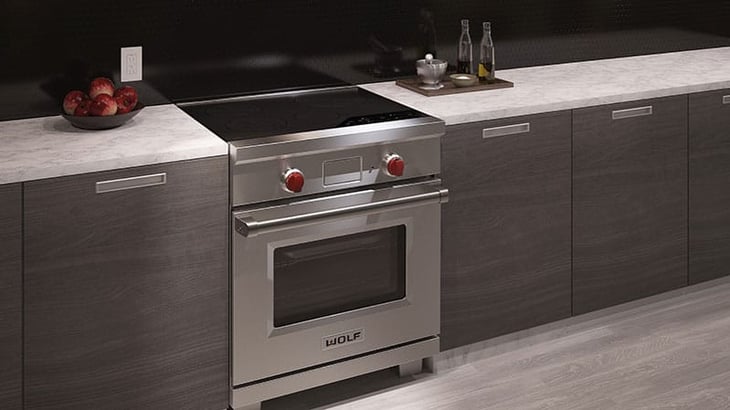
At 30 inches there is no griddle, no grill, and no second oven to argue about. You are comparing four or five burners against four or five burners.
Induction wins that comparison outright. It boils faster, simmers lower, wipes clean, and stays cool enough to touch between the pans.
If you are shopping a 30-inch range, buy induction and do not overthink it.
Unless, of course, you live somewhere with frequent power outages, or you own expensive non-metallic cookware.
36-Inch Ranges: Griddles, Grills, and Real Direct Heat
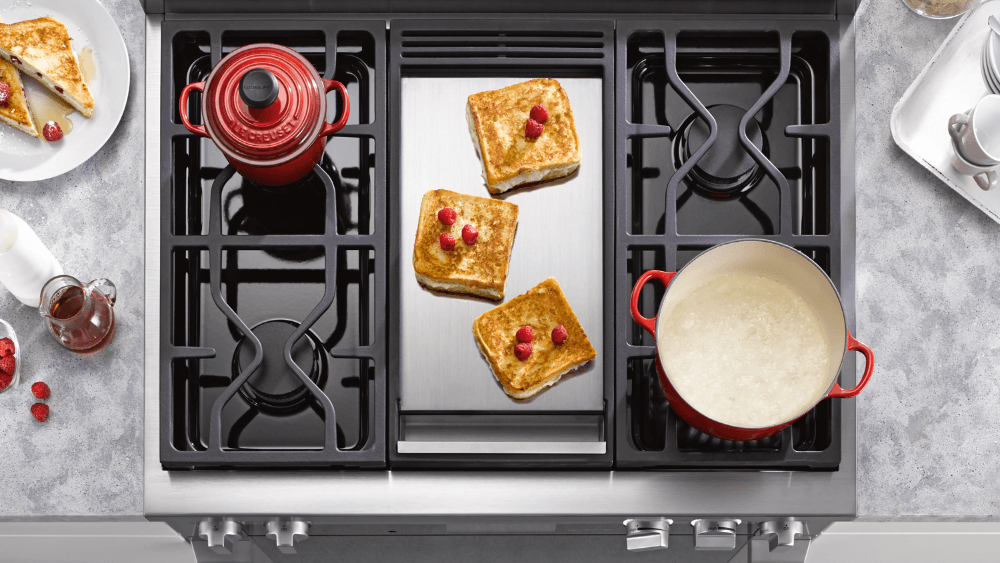
At 36 inches the cooktop opens up, and the argument changes.
You can order a griddle.
A chromium griddle is a solid cooking surface built into the range, so you cook directly on the metal.
It holds heat better than a griddle plate set over a burner, and it is simple to clean. SKS and JennAir both build them.
You can also get a real grill, which is the infrared, direct-heat kind that Wolf and Monogram put into a pro range.
Induction cannot give you that.
You can bridge two elements and set a plate on top, but you are approximating something the other range does properly.
48-Inch and 60-Inch Ranges: Sous Vide, Steam, and Speed Ovens
At 48 inches the cooktop opens up again. If you grill, you can order a double grill, and if you griddle, you can order a double griddle.
You can also order a French top, which Wolf and BlueStar both offer.
With induction, you are only adding burners. With dual fuel, the ovens themselves can change too.
SKS Builds Sous Vide Into Its Range
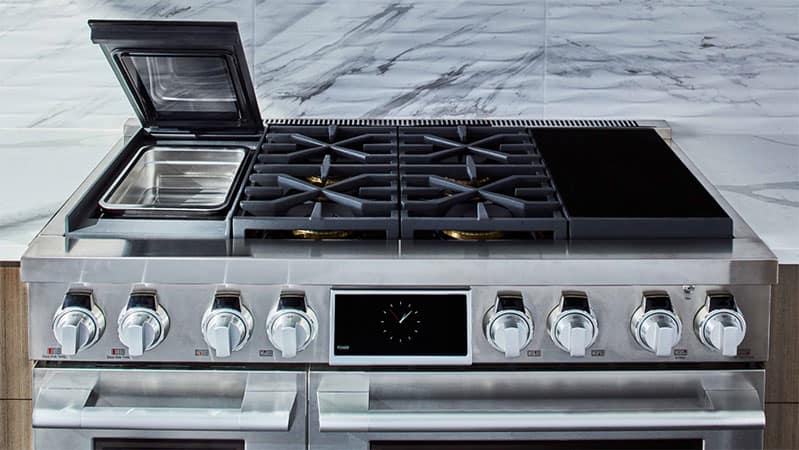
SKS adds something nobody else does. It builds sous vide into its 36-inch and 48-inch ranges, which is precision cooking in a water bath.
It holds an exact temperature and reheats more evenly than anything else in the kitchen.
It does not stop at the cooktop, and this is the part your salesperson will probably never bring up.
Thermador and SKS Build a Steam Oven Into a 48-Inch Range
.jpg?width=799&height=449&name=Thermador-Professional-Range-With-Steam-Oven%20(1).jpg)
At 48 inches, dual fuel gives you specialty ovens that induction simply does not offer. Thermador and SKS will build in a steam oven.
Steam adds moisture instead of driving it out, so food is juicier and reheating is better. A few extra minutes will not ruin dinner.
Miele Builds a Speed Oven Into a 48-Inch Dual Fuel Range
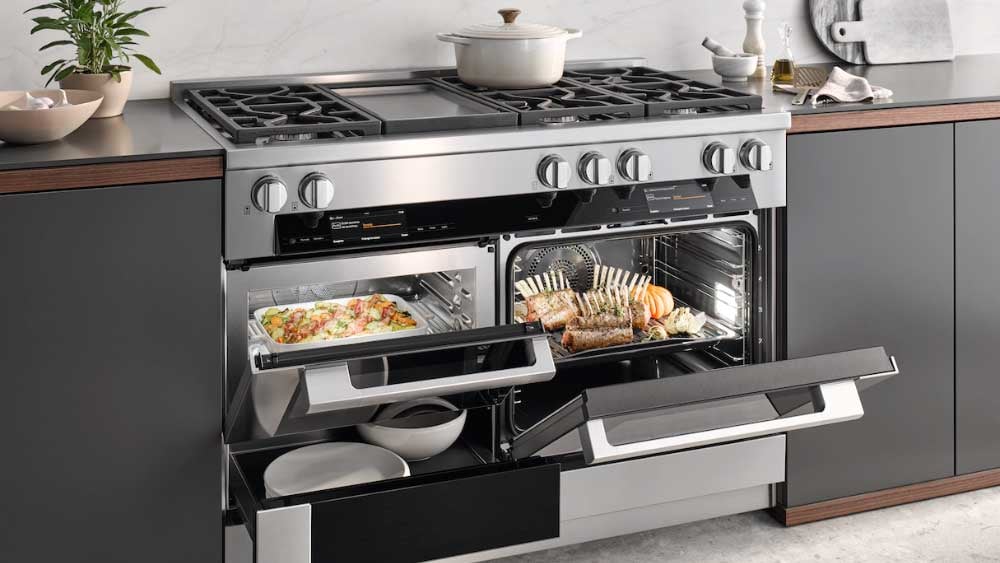
Miele will build in a 48-inch speed oven that combines convection and microwave in one cavity.
You get microwave speed without the rubbery microwave texture.
A 48-inch induction range gives you two conventional ovens. That is the entire menu.
🔍 Read more: The Best 48-Inch Professional Ranges
So Should You Buy a Dual Fuel Range or an Induction Range?
Work backward from how you cook, not from the technology.
Buy induction if:
- You are shopping a 30-inch range, where you are only comparing burners
- Most of your cooking happens on the cooktop
- Speed, simmer control, and easy cleanup are what you actually want
- You have young children or aging parents in the kitchen
- Your local code has closed the door on new gas service
Buy dual fuel if:
- You are shopping 36 inches or wider and want a grill, a griddle, or a French top
- You want sous vide built into the range, which means SKS
- You want a steam oven or a speed oven in the range instead of in the wall
- You cook enough to use a second cavity that is not just a second oven
If you want help sequencing the whole decision, we wrote five steps to buying the right range for exactly this.
What Do Buyers Get Wrong About Dual Fuel and Induction?
Mistake One: Assuming Induction Is a Straight Upgrade at Every Size
Mistake one is treating induction as a universal upgrade. At 30 inches it is one. At 48 inches you are trading away half the configuration options in the category.
Mistake Two: Assuming Dual Fuel and Induction Bake Differently
Mistake two is assuming the ovens are different. They are not. Dual fuel and induction both bake with dry electric heat, from the same kind of electric element.
If moist oven heat and an infrared broiler are what you are after, that is an all-gas range, not a dual fuel one.
Mistake Three: Budgeting for the Range but Not the Electrical Panel
Mistake three is pricing the range and forgetting the panel. Both technologies need a dedicated 240-volt circuit, and induction ranges typically need 50 amps.
In an older Boston-area home that means an electrician, new wiring, and sometimes a panel upgrade.
🔍 Read more: What's the Difference Between All Gas and Dual Fuel Ranges?
The Bottom Line: Dual Fuel Still Wins Above 30 Inches
So which should you buy, induction or dual fuel? Two words: that depends.
Induction is the better burner. Dual fuel gives you more options.
Induction is faster, simmers better, and is safer, with less venting. But gas can still be lit when the power is out, and it does not need special cookware.
This comparison is about more than burners. It comes down to how you cook.
Do you grill or griddle? Would you use a French top? Then consider dual fuel.
For the oven, you have more choices than two conventional cavities. At 48 inches and 60 inches, you can add a steam oven, a speed oven, or sous vide on the cooktop.
At 30 inches, buy induction. Above 30 inches, dual fuel is the only way to get a grill, a griddle, a French top, or a steam oven.

Additional Resources
Read our Induction Cooking Buying Guide for features, buying tips, and ratings of every available induction cooking product in the market. Well over 1 million people have read a Yale Guide. Induction is our most popular.

Why Should You Trust Us?
It seems that every appliance review has nothing but glowing comments about almost every product, yet you read customer reviews and they are almost universally bad.
We are here to fill in the disconnect. We'll give you the best features, and the drawbacks as well, including reliability based on over 33,000 calls performed by our service team just last year. Our goal is to give you ALL the information so you know what's right for you.
Please consider subscribing or adding to the conversation in the comments below. We appreciate you stopping by.