

If you're reading this, you're probably at a real decision point.
Maybe you're remodeling, and the cooktop is the one choice you keep going back and forth on. Or maybe your old gas range is on its way out, and you're finally wondering whether to switch.
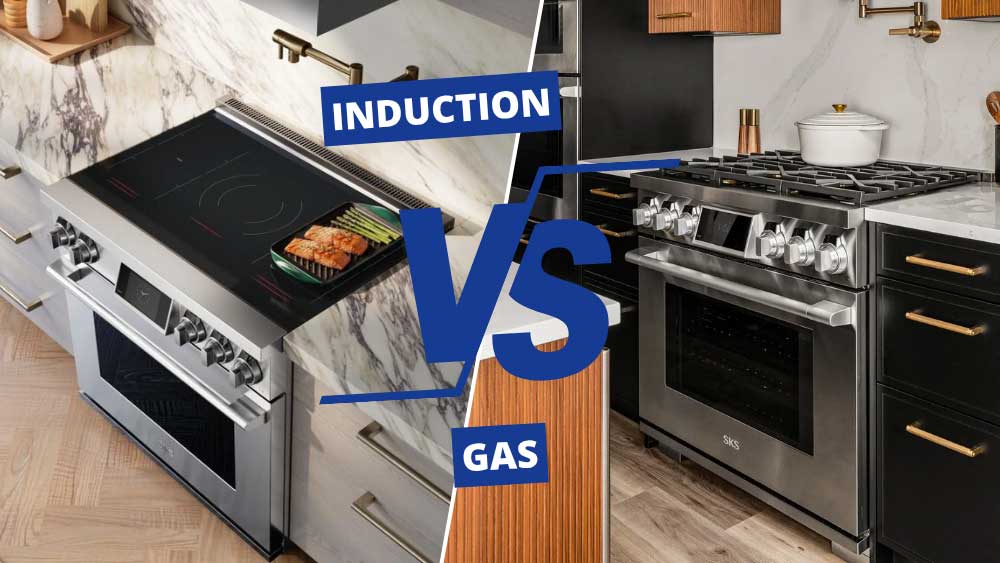
Either way, the question underneath it is the same: gas or induction, and which one is right for your home?
That's what this article will help you answer. You'll learn how induction and gas cooking work, where each one wins, and what it really costs to switch in the Boston area.
You'll also learn the practical catches nobody mentions until it's too late, from cookware to power sharing to a pacemaker consideration worth resolving early.
Induction is the better cooking technology. But the right question isn't "induction or gas." It's "induction or gas for my house, my cooking, and my service area."
After 33,000 service calls, we can tell you it comes down to a few things that actually matter. Here's where to start.
In this article
Induction vs. Gas Cooking Comparison Chart for 2026

How Do Induction and Gas Cooking Actually Work?
Before we get into the comparison, it helps to understand what each technology is doing under the pan.
How Does Induction Heat Your Pan?
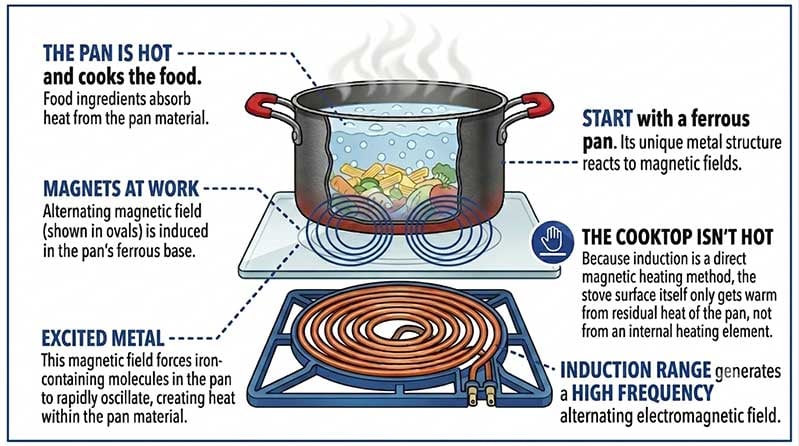
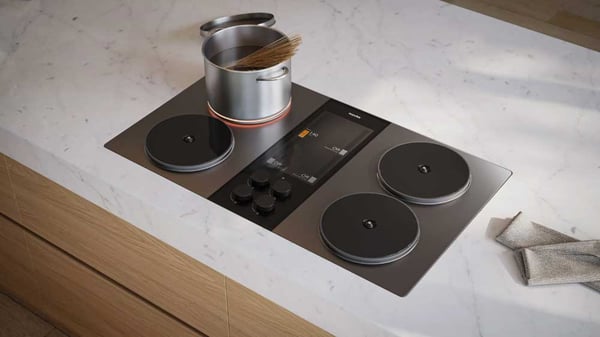
Induction uses magnetic energy to heat the pan directly. An electromagnetic coil sits underneath the glass surface.
When you place a magnetic pan on top, the coil excites the molecules in the pan itself.
The pan becomes the heat source, and the glass stays much cooler than it would on a radiant electric cooktop.
This one detail drives induction's speed, its simmer control, and most of its safety advantages.
How Do Gas Cooktops Work?
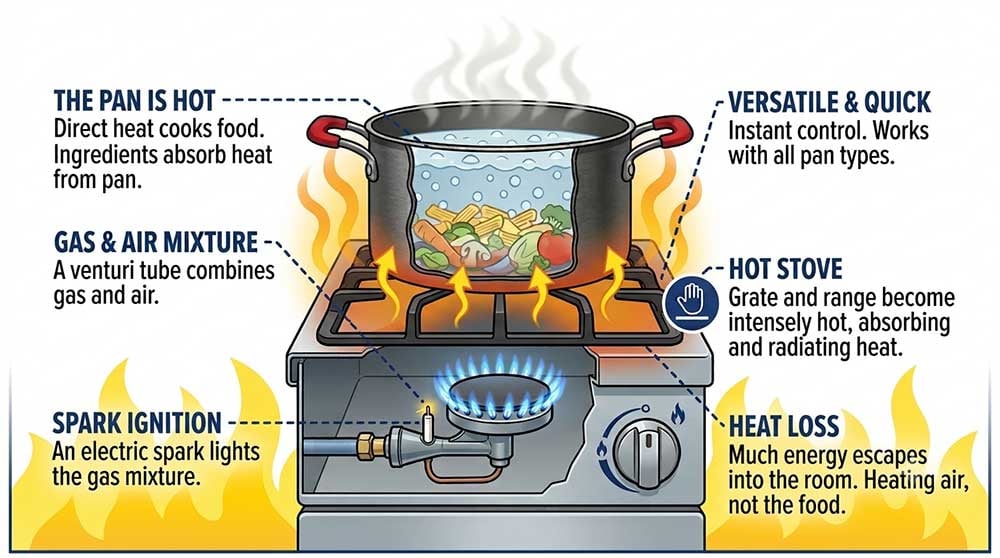
Gas works very differently. A burner mixes natural gas or propane with oxygen, and a spark ignites the mixture.
The flame transfers heat directly to the bottom of the pan, but a significant portion of that energy escapes around the sides of the pan and into the room.
Gas is responsive, intuitive, and works on essentially any cookware. That's why it's been the default for so long.
Where Does Induction Outperform Gas?
Induction wins in several categories. Here's where it actually outperforms gas, in roughly the order that matters most to you.
Boiling and Cooking Speed
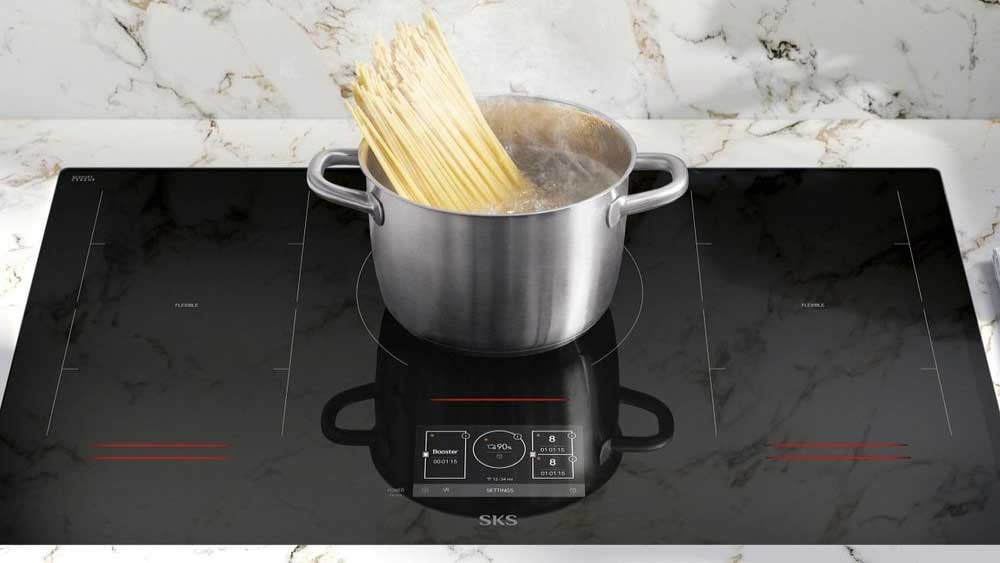
The most powerful induction burners now go up to 7,400 watts, enough to boil a pot of water in minutes.
We've run side-by-side tests where a 7,000-watt induction burner brought a gallon of water to a boil in three minutes and twenty-seven seconds.
A 23,000 BTU professional gas burner took thirteen minutes and thirty seconds for the same gallon. That's nearly four times slower than one of the most powerful gas burners we sell.
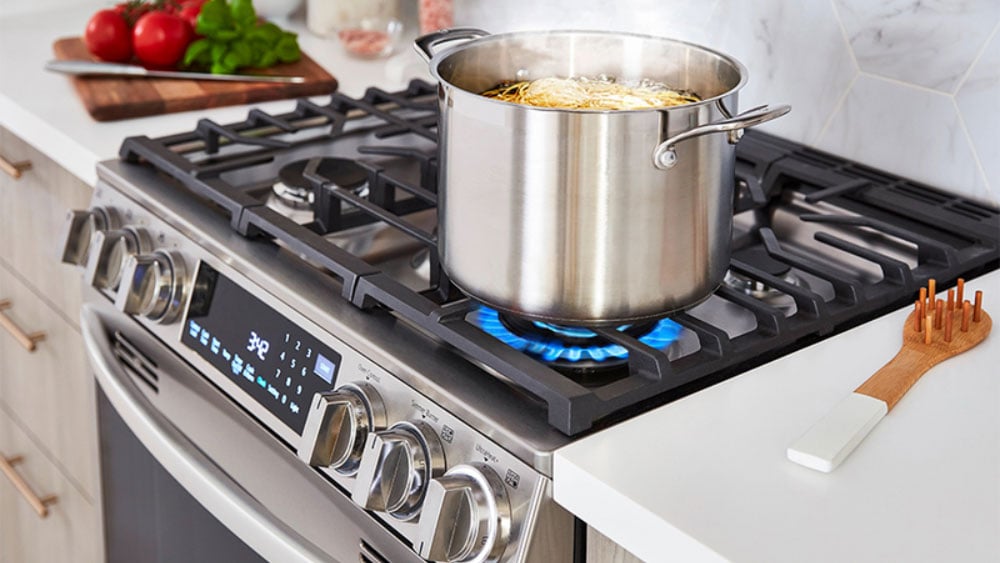
Speed extends beyond water. Searing, sautéing, and high-heat work all happen faster on induction, because more of the energy goes into the pan instead of the air around it.
🔍 Read more: The 3 Fastest Induction Cooktops for 2026.
Simmer Control and Low-Heat Precision
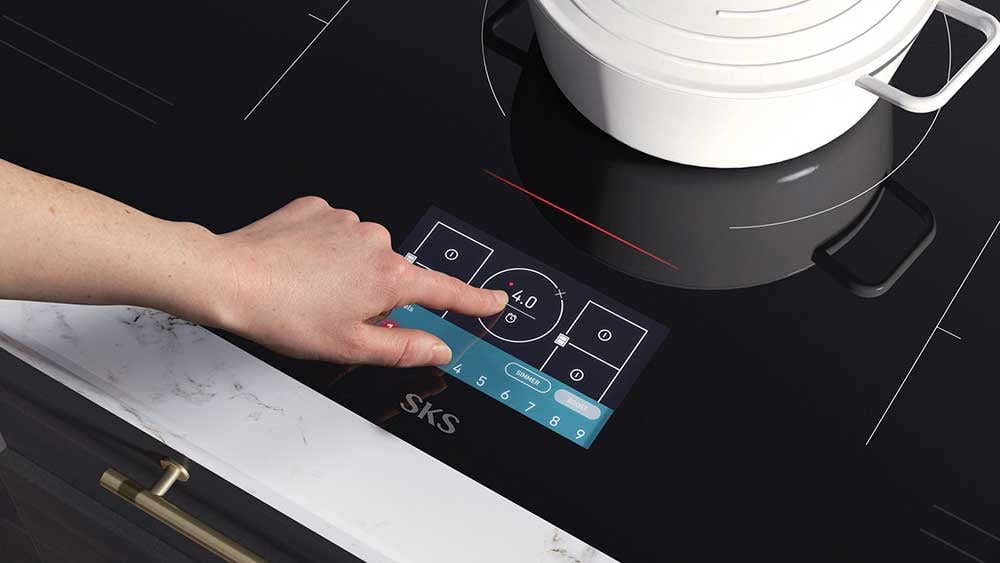
The advantage that will surprise you most is at the other end of the dial.
Induction can simmer almost down to a single watt, and it holds that temperature precisely.
Gas struggles at very low heat, because the flame can extinguish if you turn it down too far.
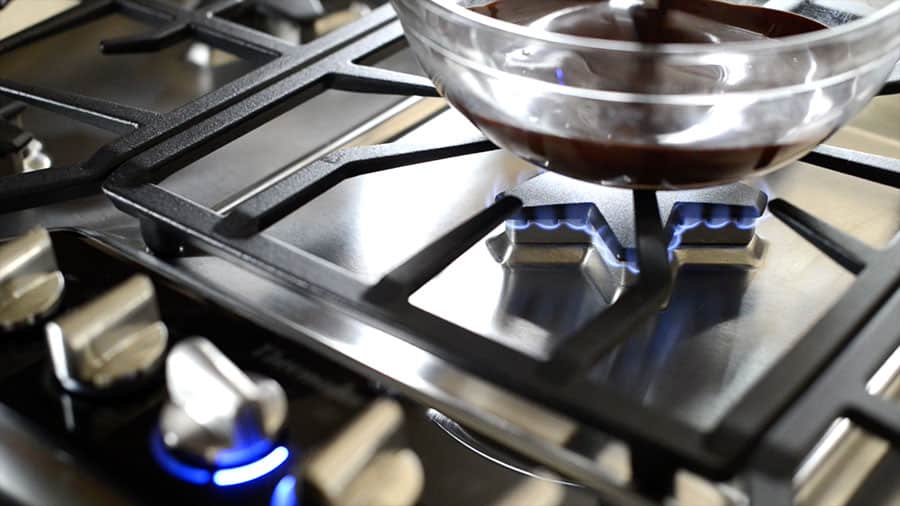
Even the best professional gas burners can't match induction's low end. Thermador and SKS offer simmer settings as low as 100 BTU, but they run on an intermittent cycle, meaning the burner has to turn on and off to hold the setting.
Induction still wins for holding a delicate sauce or melting chocolate without scorching.
Electric is worse still. The glass and burner stay hot long after you turn the heat down.
Induction gives you both ends of the range: instant high heat when you need it, and true low heat when you don't.
Cooktop Cleanup and Maintenance
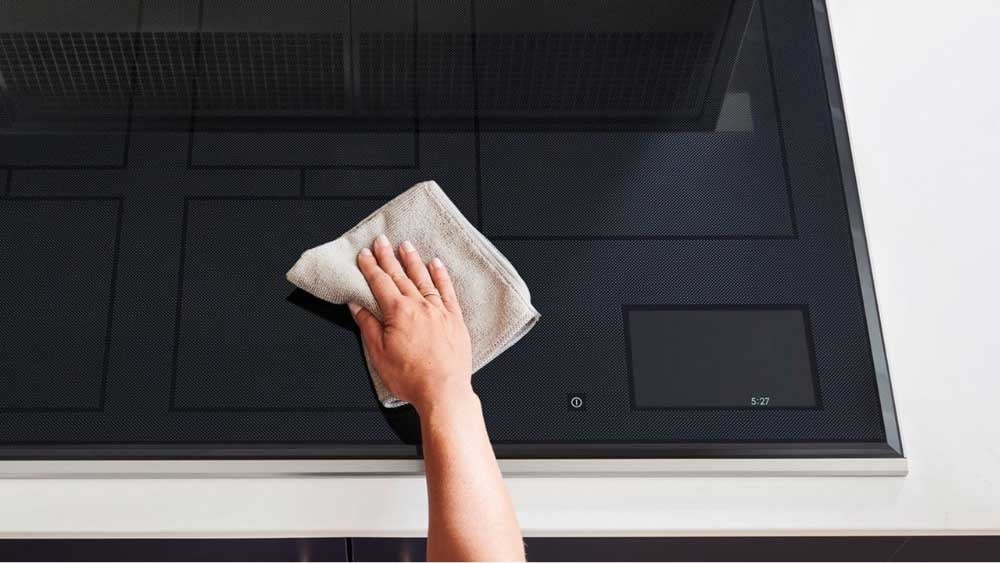
Because induction heats the pan rather than the glass, spills are less likely to bake on.
The surface gets warm from the pan sitting on it, but it doesn't stay hot the way a gas grate does.
There are no grates or burner caps to scrub around.
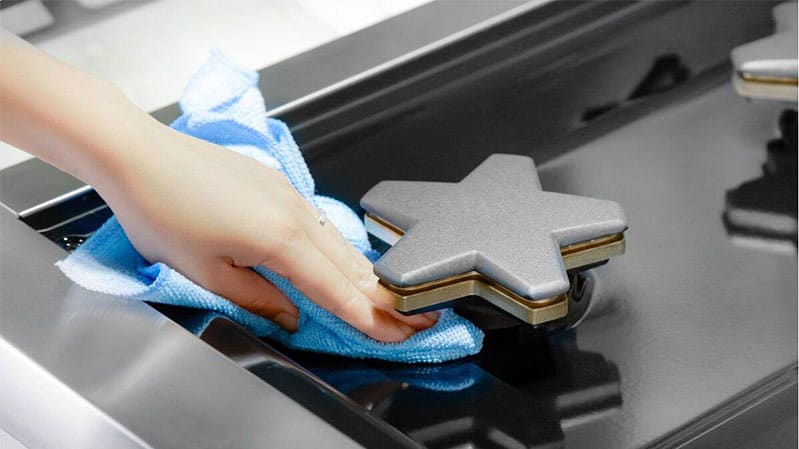
For shorter cooking sessions, you can even put a thin layer of paper towel or a silicone mat under the pan to catch splashes, something you definitely can't do with a gas burner.
Kitchen Safety for Kids and Seniors
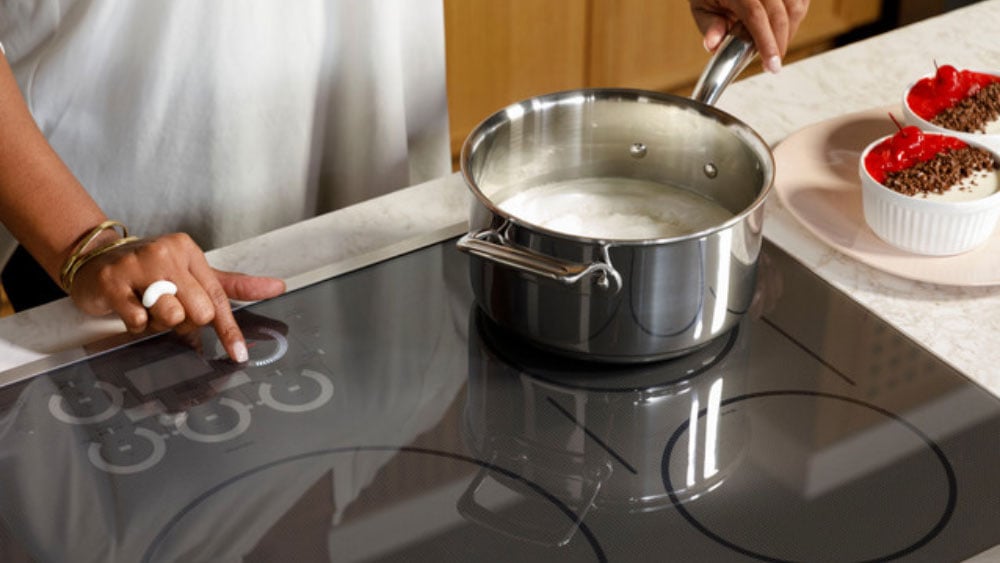
If you have small children in the house, or you're caring for an aging parent who still likes to cook, induction is safer than gas for two reasons.
First, induction won't turn on without a magnetic pan on the burner. If a child climbs up and taps the controls, nothing happens.
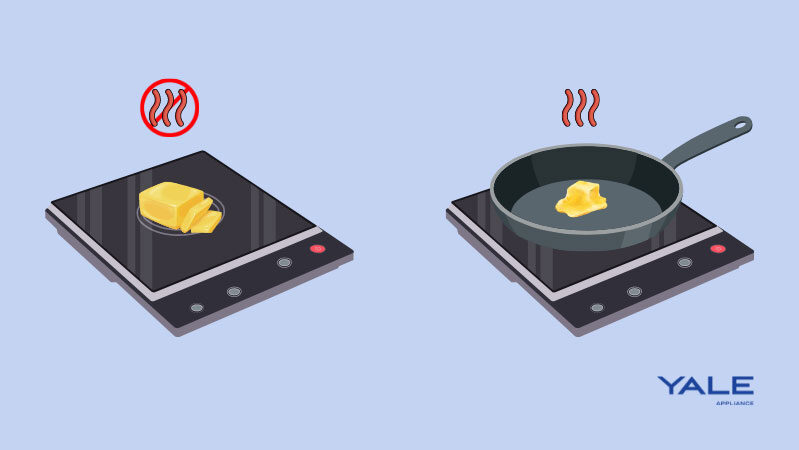
Second, the glass only gets warm from the pan sitting on it. There's no open flame and no actively heated surface.
You can still burn yourself if you touch the glass right after lifting a hot pan off it, but the risk of a serious burn is much lower than with gas.
A Cooler Kitchen and Cleaner Indoor Air

Up to 40 percent of the heat from a gas burner escapes around the pan and into the room.
If you've ever cooked a full dinner on a gas range in August, you know what that feels like.
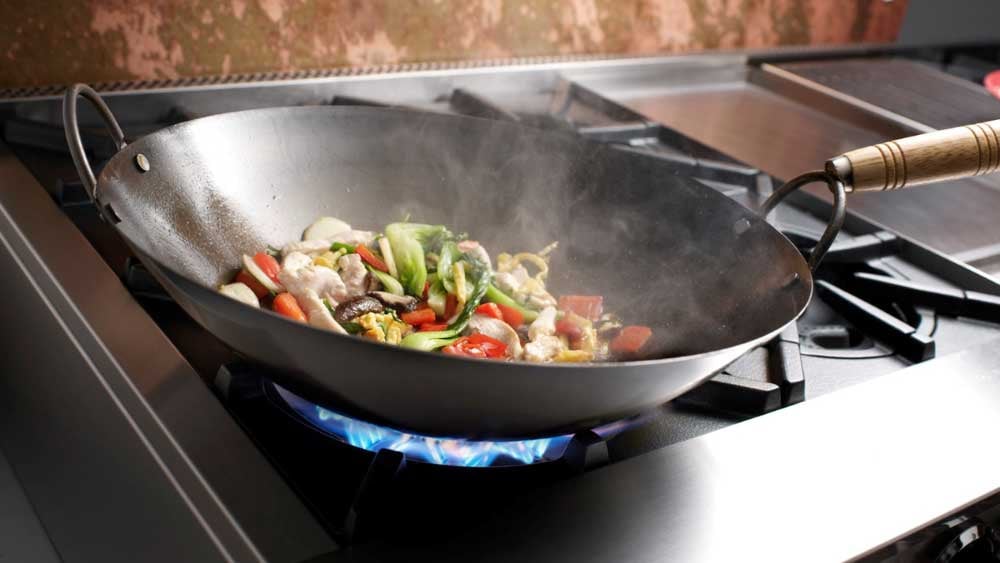
Induction is 90% efficient and puts almost all of its energy into the pan, so your kitchen stays cooler while you cook.
There's also an indoor air quality angle. Gas combustion produces small amounts of nitrogen dioxide, formaldehyde, and other byproducts. Induction produces none of that.
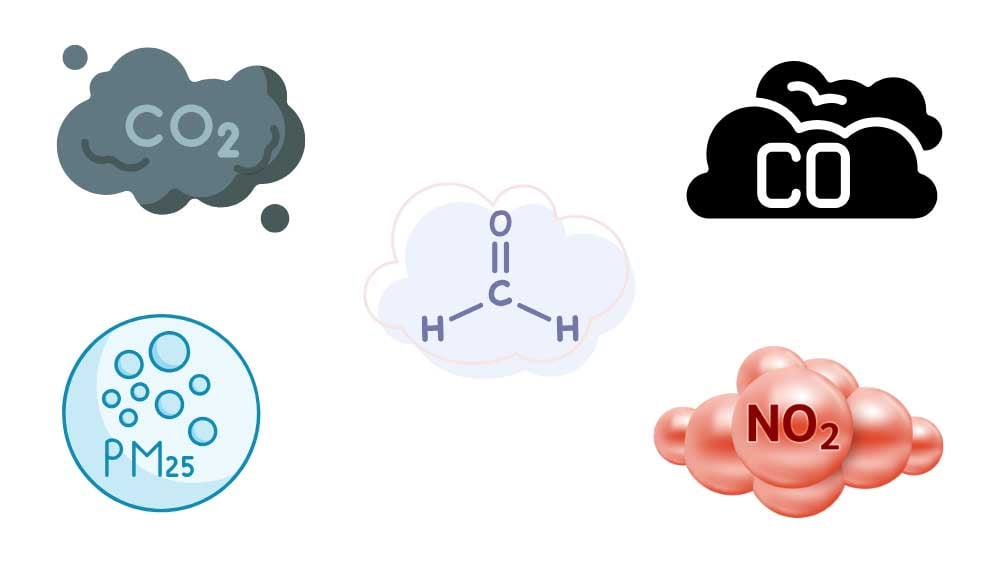
This doesn't mean you can skip ventilation on induction. If you're frying, searing, or producing smoke or grease, you still need a proper hood.
But the air in the room itself is cleaner with induction, and that matters more than you might expect.
Flexibility With Larger Cookware and Bridge Elements
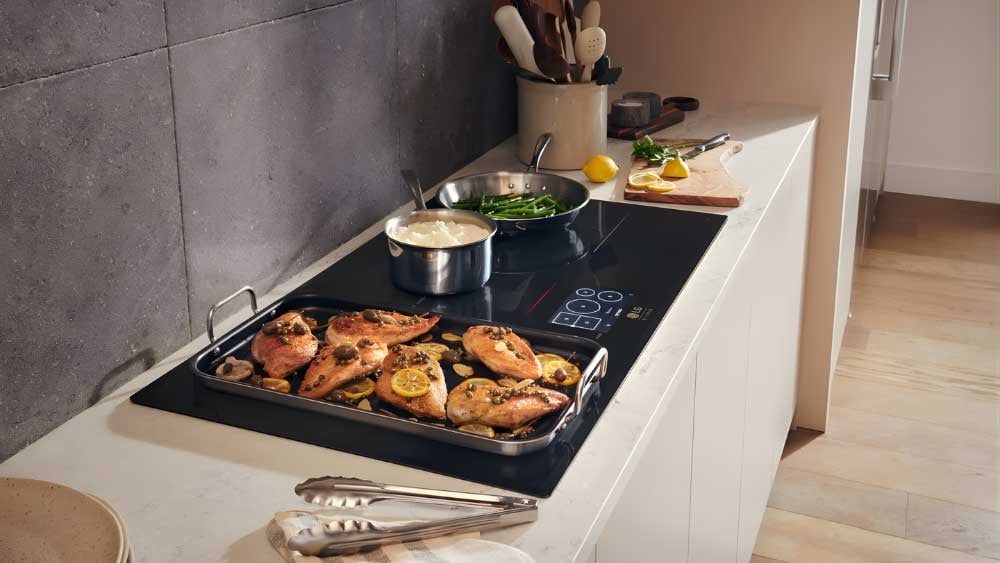
A detail that's easy to miss is how much more usable induction has become for non-standard pans.
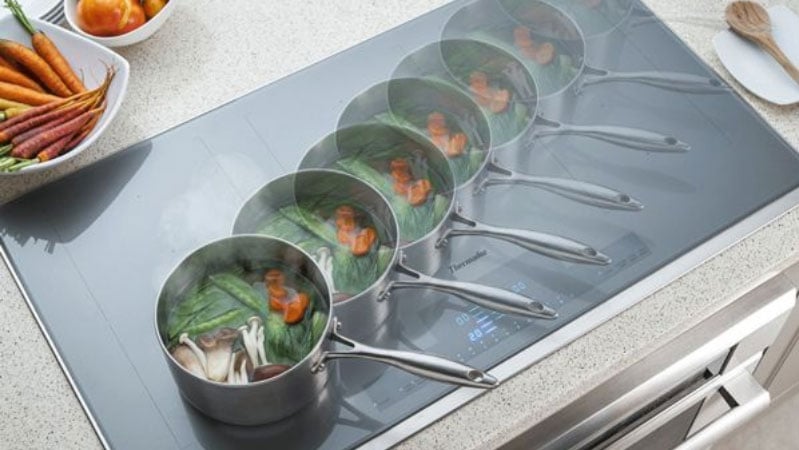
Many of the better cooktops now offer bridge elements, where two cooking zones combine into one continuous heating area. That lets you use a long griddle, an oval roaster, or a fish pan without losing performance.
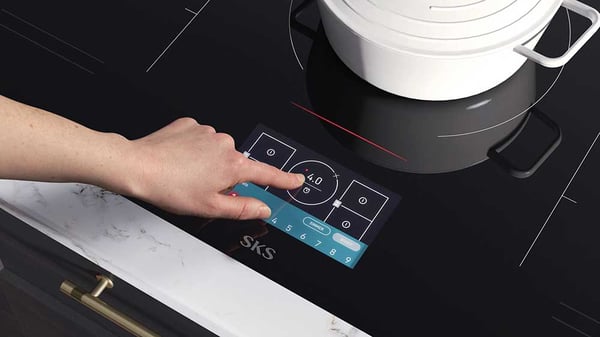
A few cooktops go further with full-surface designs that let you place cookware anywhere on the glass. The era of small round pots on small round burners is over.
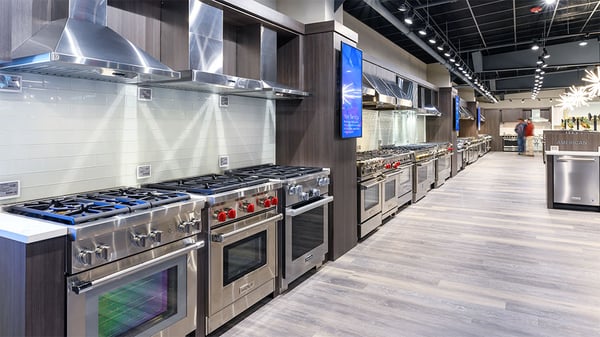
Curious what induction feels like in a working kitchen? We have live induction cooking on display at all six of our showrooms across Massachusetts, southern New Hampshire, and Rhode Island.
Book a showroom visit to see it before you commit to gas or induction.

What Does It Cost to Switch From Gas to Induction?
Induction isn't a plug-and-play replacement for gas, and the costs of switching add up quickly. The good news is that you can know all of them before you buy.
Electrical Work for Induction Ranges and Cooktops
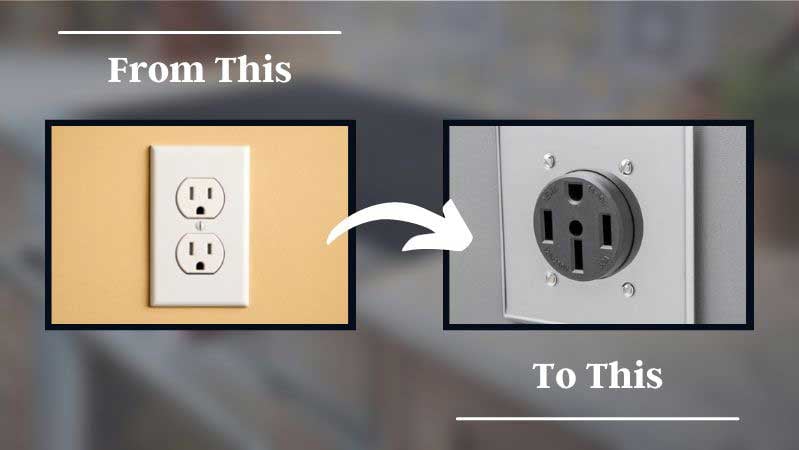
This is the big one.
A gas range or cooktop runs on a standard 120-volt outlet at less than 12 amps, essentially the same as plugging in a microwave.
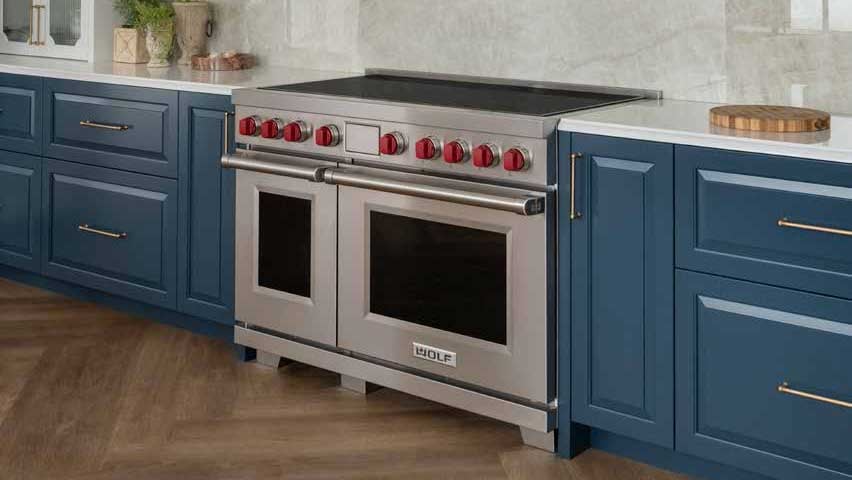
Most induction units need a 240-volt connection at 30 to 50 amps, and a 48-inch professional induction range requires a dedicated 50-amp circuit at minimum.
One brand, Wolf, requires two 50-amp circuits on its 48-inch model, a combined 100 amps of dedicated capacity.
We had a client whose gas range pulled 12 amps. After she switched to a 48-inch Wolf induction, her load jumped to 100 amps.
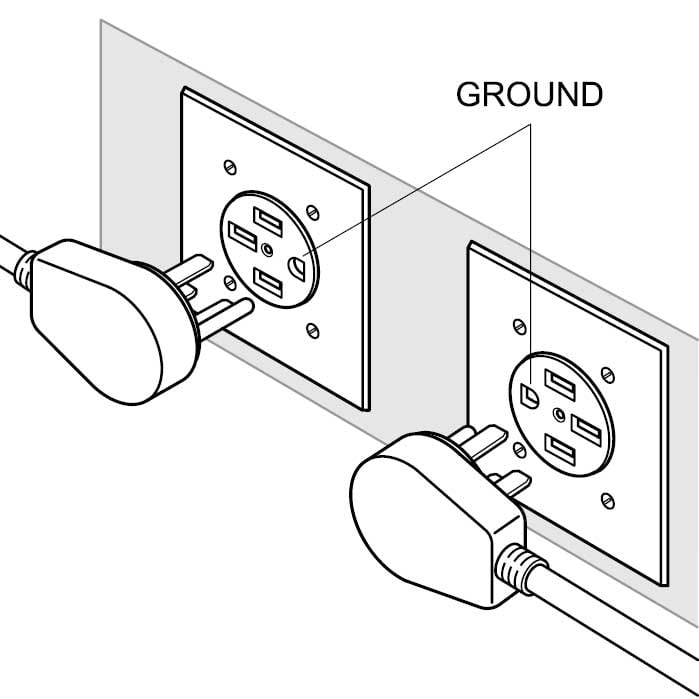
That eight-fold increase in electrical capacity meant rewiring much of the kitchen.
None of that work shows up in the price of the appliance. You typically don't find out about it until the electrician walks through.
🔍 Read more: 6 Steps to Convert Your Gas Range to Induction
Induction Cookware Requirements
Induction only works with cookware that has enough ferrous (magnetic) metal in the bottom for the coil to interact with.
The simplest test is to hold a refrigerator magnet to the bottom of your pans.
If it sticks firmly, the pan will work. If it slides off or only sticks weakly, the pan isn't induction-compatible.
Most stainless steel and all cast iron will work. Aluminum, copper, and many older copper-core pieces will not.
Replacing a full set of pans can run another $500 to $2,000, depending on what you currently own and your budget.
Why Do Some Induction Cooktops Hum?
Some induction cooktops produce a low hum or buzz, and it almost always comes down to your cookware.
The noise is the electromagnetic vibration between the coil and the pan, not a defect.
Lightweight pans, or pots with less metal in them, are the usual culprits. With the right cookware, induction is silent.
Heavier, flat-bottomed pans with higher iron content don't hum, so if you're hearing noise, the pan is the first thing to check.
What Do You Give Up When You Switch to Induction?
A few specific things you can do on gas, you can't do on induction.
If you like to flip food by lifting and tilting the pan off the burner, induction may cut out mid-toss, because it has lost contact with the metal.
If you regularly char tortillas, peppers, or marshmallows directly over the flame, that isn't possible without an open flame.
Pro Range Cooking Flexibility
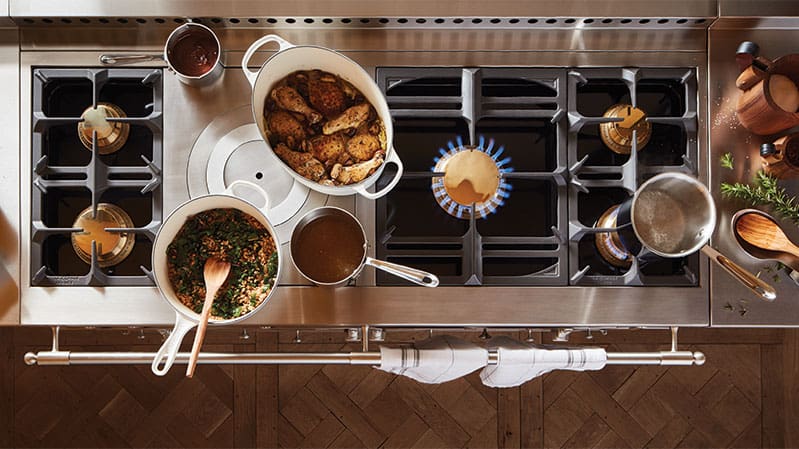
You also give up some configuration flexibility at the top of the professional range market.
If you're shopping for a true pro range, gas and dual fuel still offer a wider set of cooktop layouts than induction does.
Brands like SKS, Thermador, and Wolf give you far more to work with on the cooking surface, including specialty burners you simply can't replicate on induction.
You have options like griddles, French tops, grills, and Sous Vide that are not available in induction yet.
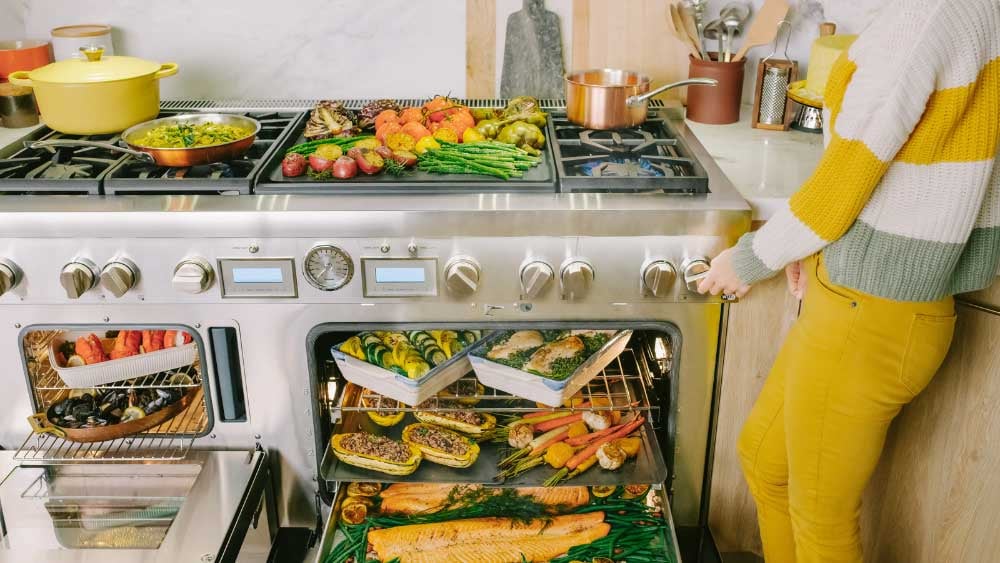
If your cooking depends on that kind of specialized surface, gas or dual fuel gives you configurations induction can't match yet.
Induction has closed a lot of the gap with bridge elements and flex zones, but at the very top of the professional lineup, dual fuel still holds more variety.
How Does Power Sharing Work on Induction?
When you read that an induction cooktop has a 7,000-watt burner, that doesn't mean every burner delivers 7,000 watts at the same time.
Induction cooktops share power across their elements, so when one burner is boosted to its maximum, the burners around it scale back.
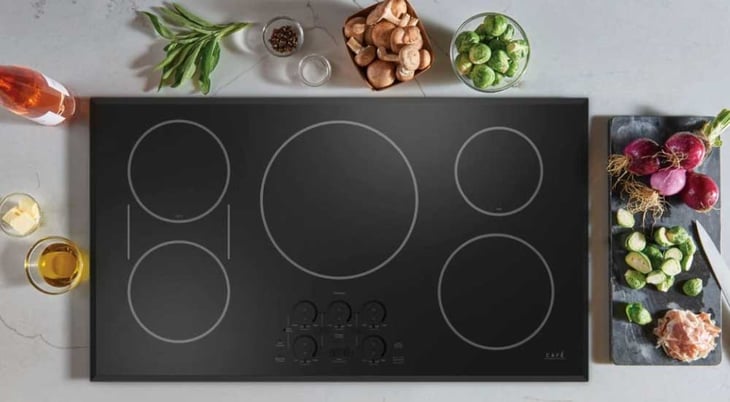
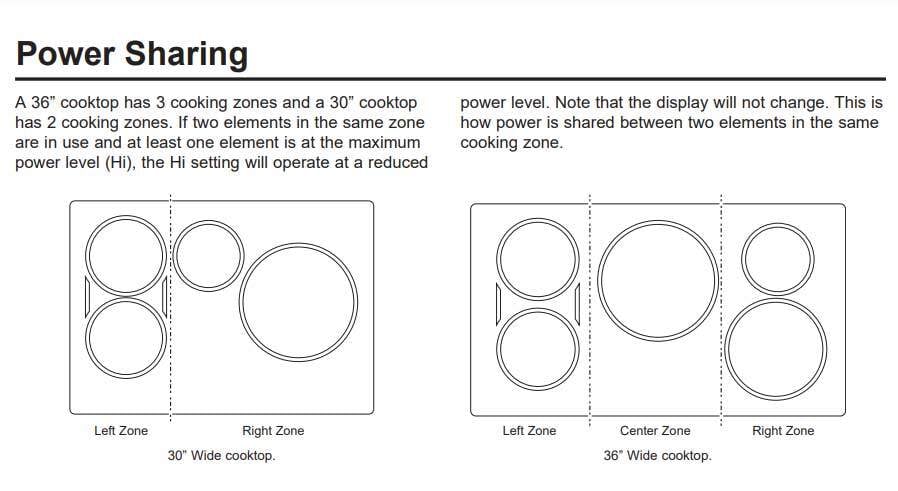
You still get the speed when you need it. You just don't get every burner at full output at once.
Most gas cooktops work the same way in practice. The highest-output burner sits in front, and lower-output burners sit in back.
Power sharing is simply more explicit on induction.
🔍Read more: How Power Sharing and Power Boost Impact Induction Cooktop Performance.
Is Induction More Reliable Than Gas?
Yale Appliance Service Rates: Gas vs. Induction
We service what we sell, and we log more than 33,000 service calls a year. Those calls are where these first-year service rates come from.
For context, our overall service rate across everything we sell is 8.3%.
Induction cooktops are the standout at 5%, which puts them among the more reliable cooking products we carry. Gas ranges also land below average at 6.9%.
Induction ranges sit just above the average at 8.7%. Gas cooktops look worst of the four at 10.3%, but that number covers a small sample size. Treat it as directional rather than settled.
🔍Read more: See how every cooking category compares in our Most Reliable Appliance Brands for 2026 guide.
Why the Gap Between Induction Ranges and Cooktops?
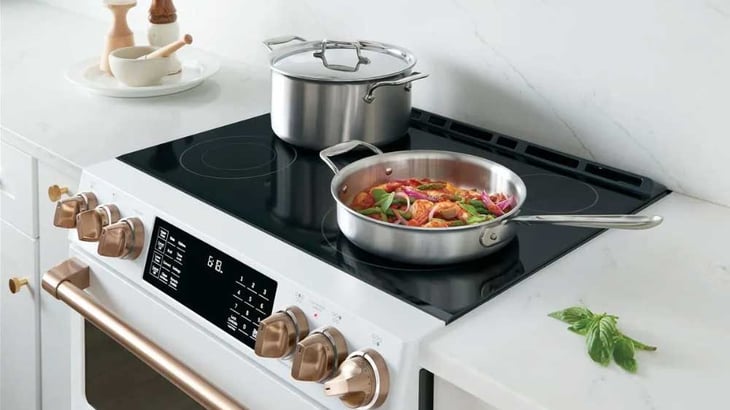
An induction range combines an induction cooktop with an electric oven in one chassis.
The larger 50-amp draw of a range puts more stress on the electronics. Cooktops usually run on 30 to 40 amps and don't see the same voltage spikes.
Bosch and Bosch Benchmark have driven the induction cooktop category to a 1.9 percent service rate, among the lowest of any appliance we sell.
🔍 Read more: The Most Reliable Induction Cooktops for 2026.
Is Induction Service Available in Your Area?
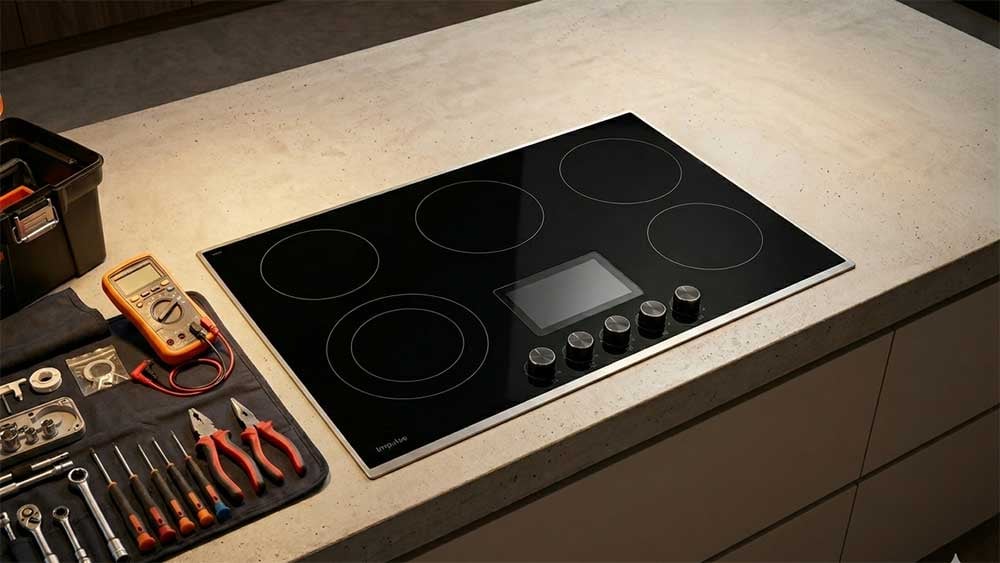
Reliability is also about who can fix the appliance when it does need service.
Gas service has been around for decades, and almost every technician in the field is trained on it.
Induction is newer and more electronic-heavy, so the pool of qualified service techs is smaller.
That matters most in places like the Cape and Nantucket, where the wait for any appliance service is already longer than on the mainland.
Before you commit to induction, ask your dealer what service availability looks like in your specific town.
What Should You Know About Induction Cooktops and Pacemakers?
This part may not apply to you, but it's important enough to call out clearly.
If you or anyone in your household has a pacemaker or an implantable cardioverter defibrillator, talk to your cardiologist or the device manufacturer before installing an induction cooktop.
Published guidance from most pacemaker makers suggests keeping at least 60 centimeters (roughly two feet) between the device and an active induction burner.
That's more distance than you typically stand from a cooktop while stirring a pot. Your device should also be MRI compatible.
We're appliance dealers, not doctors, so please take this as a flag rather than as medical advice.
It's a real consideration with induction that doesn't exist with gas or electric, and it's worth resolving before you spend the money on the electrical work.
Which Should You Choose: Induction or Gas?
Induction is the better cooking technology for your kitchen in almost every way. It's faster on the high end, more precise on the low end, easier to clean, and safer around children and older family members.
It also produces less ambient heat and fewer indoor air pollutants.
But gas may still be the right answer for you.
If your panel doesn't have spare capacity, if you cook in ways that depend on an open flame, or if local service availability for induction is limited, gas continues to make sense.
Like we said before, the right question isn't "induction or gas." It's "induction or gas for my house, my cooking, and my service area."
Want to test your existing pans before committing? Bring them into any of our six showrooms across Massachusetts, southern New Hampshire, and Rhode Island.
We have a cooktop with a pan-testing feature that reads the actual ferrous metal content of each pan and tells you whether it will work on induction. Book a showroom visit.
🔍 Read more: Best Induction Cooktops for 2026.
Additional Resources
Read our Induction Cooking Buying Guide for features, buying tips, and ratings of every available induction cooking product in the market. Well over 1 million people have read a Yale Guide. Induction is our most popular.
Related Articles:

Why Should You Trust Us?
It seems that every appliance review has nothing but glowing comments about almost every product, yet you read customer reviews and they are almost universally bad.
We are here to fill in the disconnect. We'll give you the best features, and the drawbacks as well, including reliability based on over 33,000 calls performed by our service team just last year. Our goal is to give you ALL the information so you know what's right for you.
Please consider subscribing or adding to the conversation in the comments below. We appreciate you stopping by.