

Ready to buy an induction range? Why not. It's faster, and it's safer with kids around.
But not so fast. Before you buy induction, a gas or dual-fuel range might actually be better for how you cook.
You've probably already been told induction is the obvious upgrade. Nobody mentions the 50-amp circuit, the ovens you can't order, or what happens when the power goes out.
We sell and service all three, and we logged more than 33,000 service calls last year, so we see which ones come back.
Here is what you'll learn:
- What induction actually needs electrically, and what it costs to get there
- Why the oven you end up with changes how your food comes out
- The cooktop and oven configurations induction can't give you
- How induction and gas compare on service, and who can actually fix them
In this article
- 5 Reasons Not to Buy Induction for Your Luxury Kitchen
- Induction Range Electrical Requirements and Blackouts
- Dry Electric Oven Heat vs. Moist Gas Heat
- Cooktop Configuration: Grills, Griddles, and French Tops
- Oven Configuration: Steam Ovens and Speed Ovens
- Induction Range Serviceability and Repair
- So Should You Buy Induction for Your Luxury Kitchen?
- FAQ

5 Reasons Not to Buy Induction for Your Luxury Kitchen
1. Induction Range Electrical Requirements and Blackouts
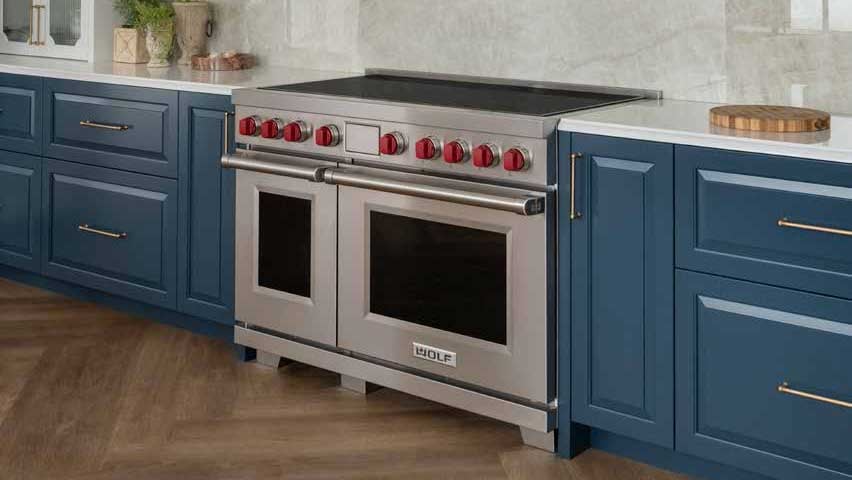
If you think you can just pull your gas range and drop in induction, it's not that simple.
A gas range barely uses any power: 12 amps at 120 volts, which is a regular outlet.
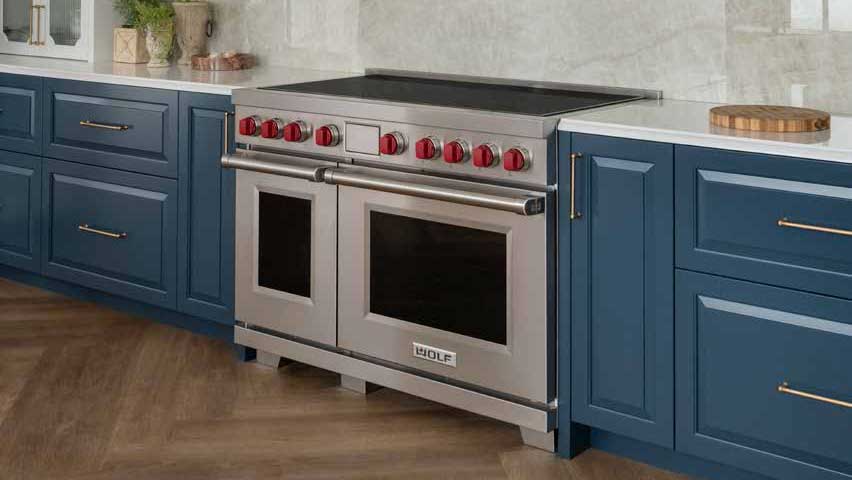
A standard induction range typically needs 50 amps at 240 volts. Go up to the Wolf 48-inch range and you're looking at 100 amps.
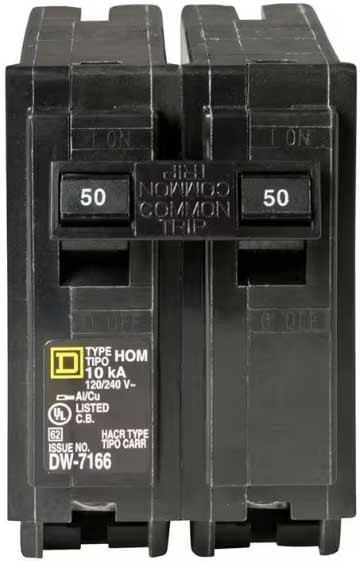
That's not a plug swap. That's an electrician, new wiring, and sometimes a panel upgrade.
If you're in a condo in Boston, you may not even have that kind of power available.
And if you do, in our market a qualified electrician typically runs $2,500 to $3,500, before you've spent a dollar on the range.
It's not just the wiring, either. If the power goes out, induction is dead. No electricity, no cooking. Gas is different: lose power, and you can still light a burner with a match.
If you're on the Cape or in Nantucket, that's worth thinking about, because blackouts happen more out there. In Boston it's less of an issue. I can remember maybe a couple of blackouts here.
🔍 Read more: 6 Steps to Convert Your Gas Range to Induction
2. Dry Electric Oven Heat vs. Moist Gas Heat
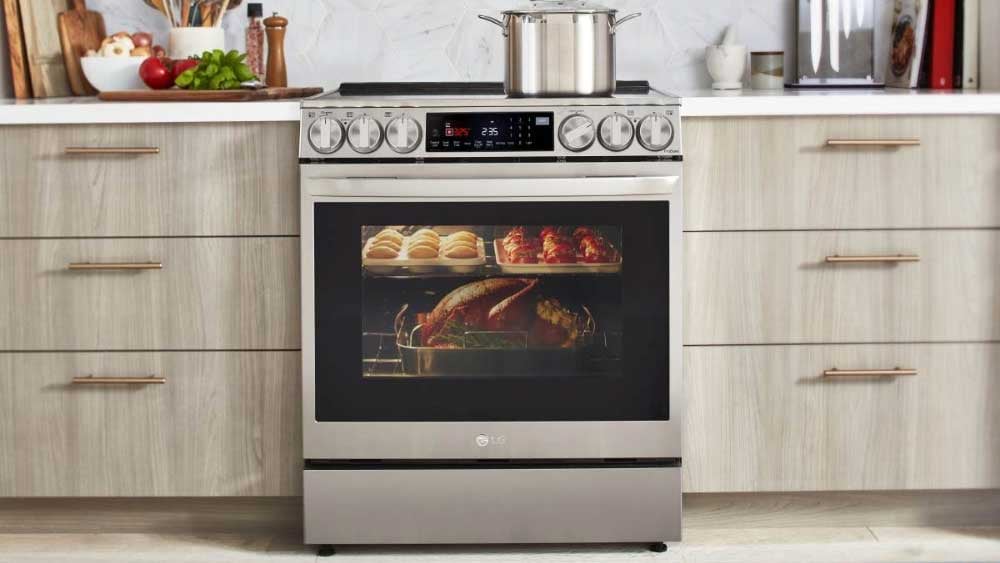
Here's the question most appliance salespeople never ask you: how do you actually use the range?
Induction is electric, and electric is dry, even heat. That's great for baking.
A full gas range is different, because burning gas adds a little moisture to the oven, and for roasting that can mean a better result.
Dual fuel doesn't give you that. The oven's electric, so it's the same dry heat as induction.
For broiling, it's not even close. Most pro ranges have an infrared broiler, which is direct heat, the same kind restaurants use.
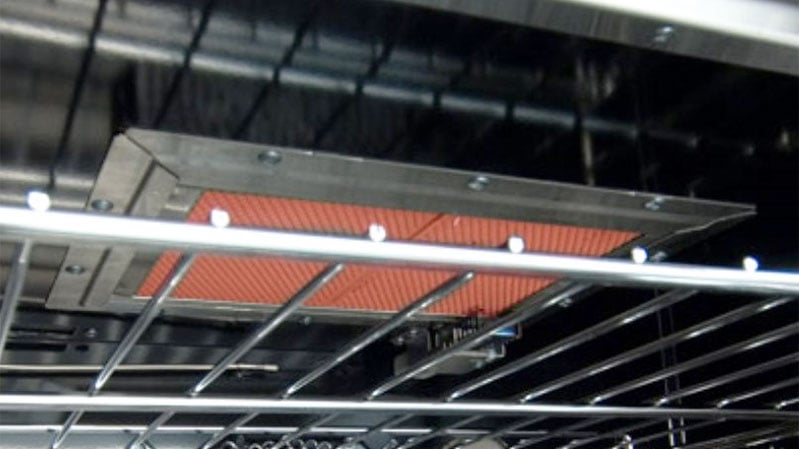
It's the same element as the sear burners on high-end outdoor grills. Dual fuel still gets an electric broiler, so you lose that too.
If you like to roast or broil, a full gas range is worth considering before you buy induction.
🔍 Read more: Induction vs. Gas Cooking (2026): The Pros and Cons Before You Switch
3. Cooktop Configuration: Grills, Griddles, and French Tops
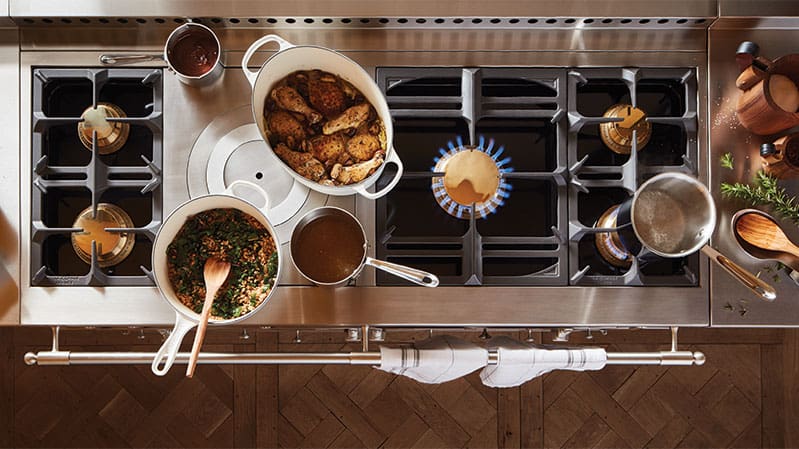
On pro ranges over 30 inches, you get real configuration options: grills, griddles, and French tops. If you like to grill, you can get a double grill.
If you like to griddle, you can get a double griddle.
You don't get that flexibility with induction.
Sure, you can griddle on induction by bridging two burners together. But a chromium griddle top is more consistent, and it's easier to clean.
And you can't grill on induction the way you can with an infrared grill built into a pro range.
SKS also gives you sous vide, which is precision water bath cooking at the exact temperature you want.
It reheats more evenly than anything else. But it's only available in their dual-fuel range.
If you're into specialty cooking and not just the basics, gas or dual fuel gives you options induction can't match.
🔍 Read more: The Best 48-Inch Professional Ranges
4. Oven Configuration: Steam Ovens and Speed Ovens
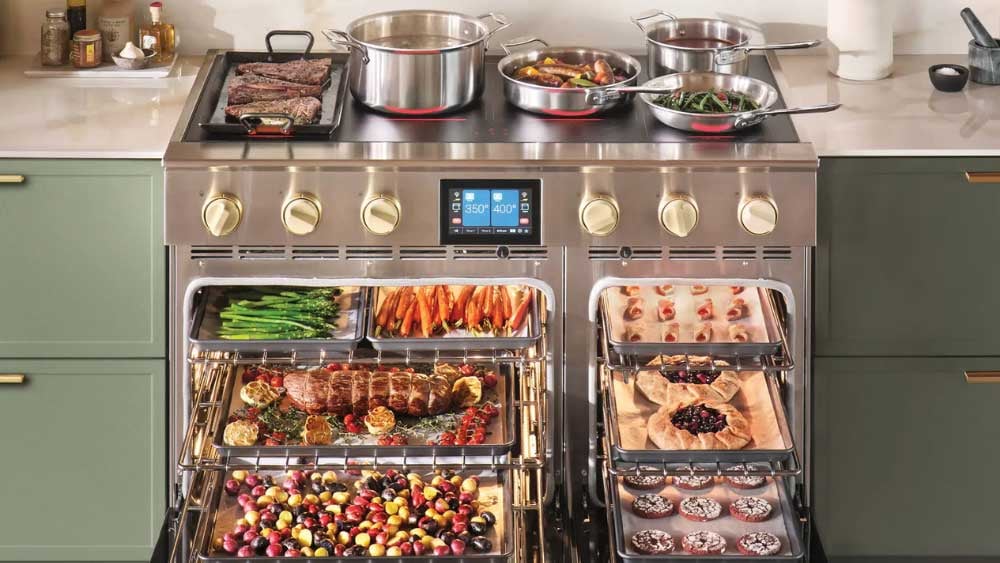
It's the same story with ovens, and this part is totally undersold. Your appliance salesperson will never tell you this.
With a 48-inch induction range, you're getting two standard ovens. That's it.
Go dual fuel at 48 inches, and SKS gives you a steam oven. Thermador gives you one too, at 48 and 60 inches.
Steam cooks better than a regular oven. It reheats better, and it adds moisture, so food comes out juicier.
It's also more forgiving: leave it a few extra minutes and it won't dry out the way a regular oven will.
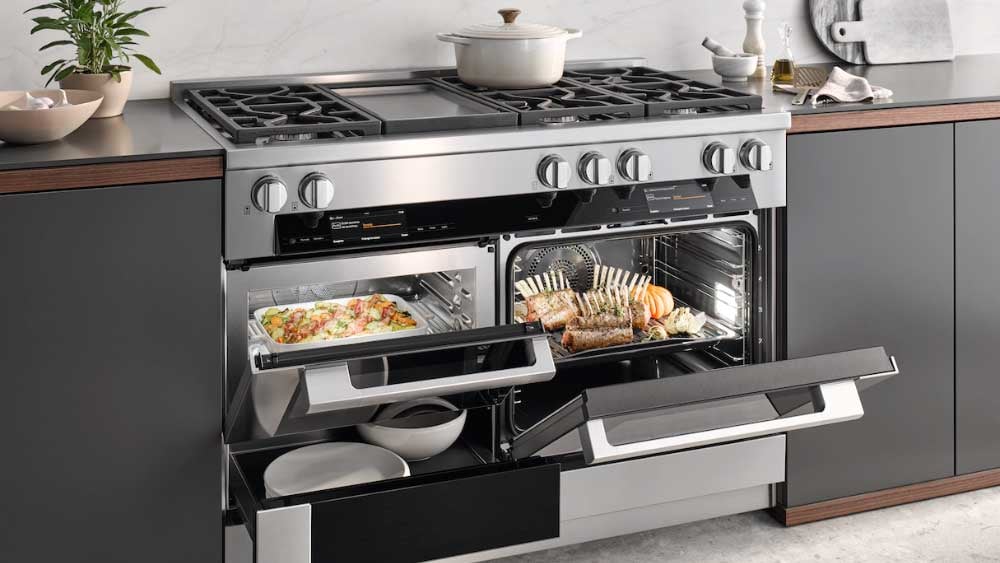
At 48 inches you can also get Miele's speed oven, which is microwave and convection combined.
Use one, use the other, or use both together and save real time, without the rubbery microwave texture.
None of that comes with an induction range.
🔍 Read more: Steam Oven vs. Speed Oven: Which Is Best for You in 2026?
5. Induction Range Serviceability and Repair
Last, and this might be the most important one: serviceability.
We logged more than 33,000 service calls last year. Across the induction ranges we sell, 8.7% came in for service in the first year. Gas ranges ran 6.9%.
Both of those numbers come from our mass-market brands, because the pro lines don't sell in the volume it takes to publish a rate.
The direction still holds: induction has more to go wrong.
And when something breaks, a gas igniter is simple to replace. An induction burner is far more complicated to fix.
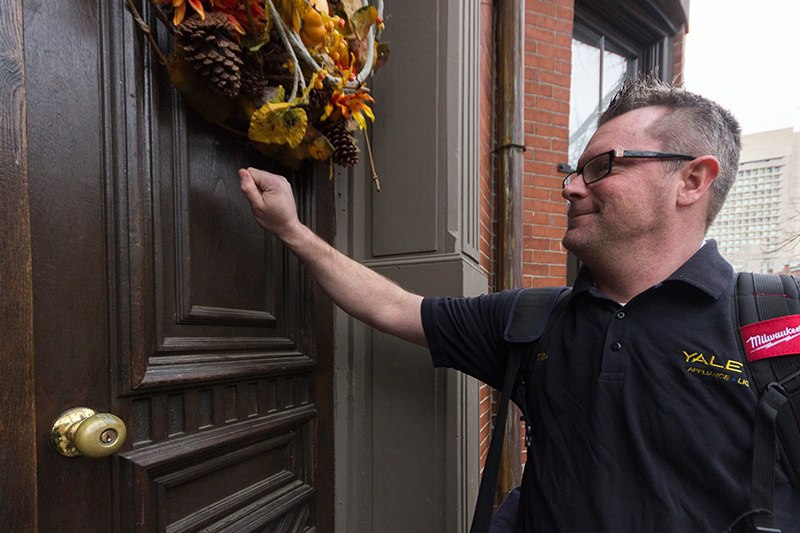
In this industry, getting a gas igniter fixed is hard enough already.
So before you buy induction, know two things: you're going to need service more often, and there are fewer people qualified to actually do it.
Make sure someone in your area can fix it before you buy it.
🔍 Read more: The Most Reliable Induction Ranges for 2026
So Should You Buy Induction for Your Luxury Kitchen?
Induction isn't a bad appliance. It's faster than gas, it's easier to clean, and it's safer with kids in the kitchen. We sell a lot of it.
The trouble is that induction gets sold as a straight upgrade, and in a luxury kitchen it isn't one. What you give up is configuration.
At 48 inches you're choosing between two standard ovens and a range that can carry a steam oven or a speed oven.
On the cooktop you're choosing between burners and the option of a grill, a griddle, or a French top.
Then there's the part nobody brings up until something breaks. Induction comes in for service more often than gas, and fewer technicians can fix it when it does.
So work backward from how you cook, not from the technology.
- Buy induction if you cook mostly on the cooktop, you want the fastest boil and the easiest cleanup, and you have the electrical capacity to support 50 amps, or 100 for the Wolf 48-inch.
- Buy gas or dual fuel if you roast or broil often, you want a grill or a griddle in the top, or you want a steam oven or a speed oven built into the range.
The best range isn't the newest technology. It's the one that matches what you actually cook.

Additional Resources
Read our Induction Cooking Buying Guide for features, buying tips, and ratings of every available induction cooking product in the market. Well over 1 million people have read a Yale Guide. Induction is our most popular.
Related Articles

Why Should You Trust Us?
It seems that every appliance review has nothing but glowing comments about almost every product, yet you read customer reviews and they are almost universally bad.
We are here to fill in the disconnect. We'll give you the best features, and the drawbacks as well, including reliability based on over 33,000 calls performed by our service team just last year. Our goal is to give you ALL the information so you know what's right for you.
Please consider subscribing or adding to the conversation in the comments below. We appreciate you stopping by.