

One of the five appliances below looks like a Dr. Seuss character designed it. The other four just never worked the way they promised.
You want technology in your appliances that makes your life easier. Every one of these products promised exactly that.
I have been selling appliances since 1986, so I watched each of them arrive with big promises. We built a display around one and tried to sell the others.
Here is what you'll learn:
- Why a commercial speed oven that works at Dunkin' couldn't make the jump to your kitchen
- How a range with a refrigerator built into it solved a problem few people had
- Why Maytag killed a $3,500 wall oven less than a year after launch
- What Thermador's own manual admitted about its fastest oven
- How the strangest-looking refrigerator of the early 2000s should have become the French door you probably own
- How to judge new appliance technology before you pay for it
Why Does Good Appliance Technology Still Fail?
These weren't bad ideas. They were good technology, aimed at the wrong kitchen, the wrong price, or the wrong company.
One more failed on looks alone, and you'll see why.
Watch for that pattern as you read, because it still shows up in new products every year.
5 High-Tech Appliances That Never Worked
Three of the five are speed ovens from roughly the same era, and that is not an accident. Around 2000, every manufacturer wanted to cook your dinner in a fraction of the time. Each one failed for a different reason.
TurboChef Speedcook Wall Oven
My kid eats hash browns from Dunkin' (always Dunkin' Donuts to me) that come out of a commercial TurboChef oven in under a minute.
Dunkin' has relied on TurboChef ovens since 2005 and had more than 11,500 of them in its shops by 2009.
Nearly twenty years ago, TurboChef built a residential wall oven around that same technology
It combined high-speed air with microwave energy, and the company claimed it cooked up to 15 times faster than a conventional oven. That's totally believable if you've ever eaten the hash browns.
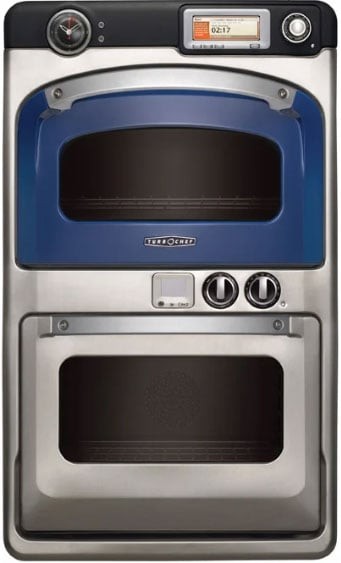 It also launched in nearly every color you could want. There were six standard door colors and more than 200 custom ones, at $5,995 for the single oven and $7,895 for the double.
What made it unique was the control system. You could cook from a menu by food type instead of guessing at time and temperature, which was well ahead of its time.
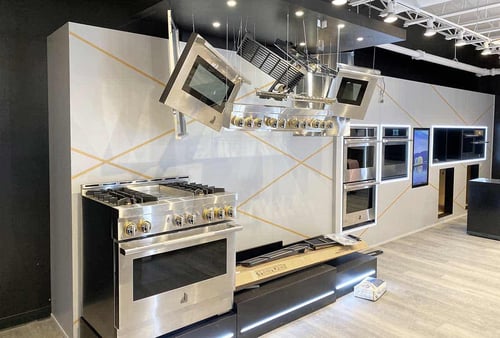
But the interface never worked right, and the cooking was never right either. I know because I built a whole display around it in a glass kitchen.
The technology itself was proven, because it still cooks everything at Dunkin' just fine. A commercial oven is built to cook the same sandwich ten thousand times, and its menu programs assume that kind of repeatability.
Your kitchen never cooks the same thing twice: different portions, different pans, different starting temperatures. That is exactly where the menu programs fell apart.
It still bothers me, because the idea was sound. Middleby bought TurboChef in 2009 and reorganized the residential business to bring its costs in line with its sales.
Whirlpool Polara Refrigerated Range
Whirlpool's Polara was a range with a refrigerator built into it.
You prepped dinner in the morning and left it refrigerated right inside the oven. Then you set a timer so it started cooking later, up to 24 hours out.
Whirlpool showed it at the 2002 International Builders' Show and put it in stores that summer for $1,799, or $1,899 in stainless.
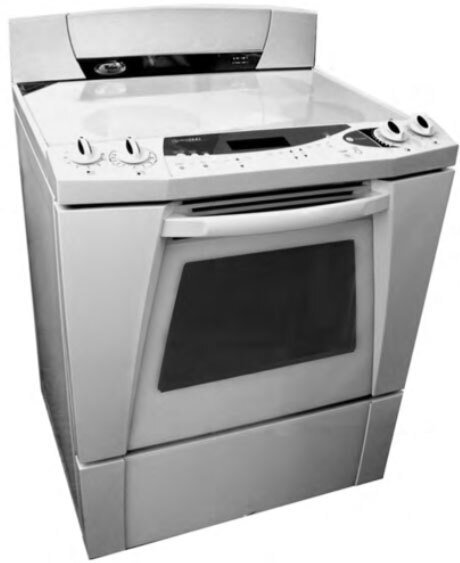 It fit a standard 30-inch opening, so it needed no special installation.
Whirlpool even tested a version you could start from a web browser or a cell phone, in a pilot with Boston-area households.
We sold exactly one, the display model, so I never really knew if it worked. Within a few years, it was gone.
Maybe you just want to cook dinner when you're ready to cook it, not program it that morning and hope for the best.
Whirlpool's own manual steered you away from loading frozen meat or poultry. The Polara needed a fresh meal, prepared ahead, on a day you'd planned in advance.
Or maybe Whirlpool, best known for its washers and dryers, wasn't the right company to sell a range this full of technology.
We'll never know.
Jenn-Air Accellis 5XP Wall Oven
In 2000, Jenn-Air launched a wall oven using the same rapid-cook technology as TurboChef. (Remember them?) TurboChef licensed it to Maytag, Jenn-Air's parent company at the time.
The "5XP" stood for five times faster than a conventional oven, or three minutes for hash browns instead of one. The price was $3,500.
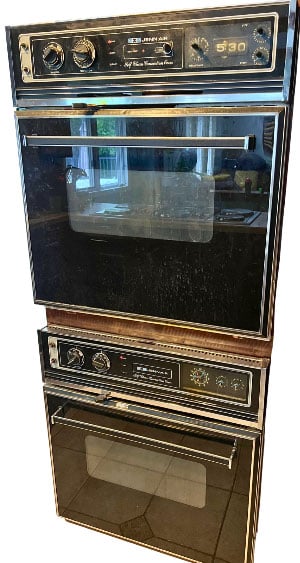 By February 2001, Maytag had pulled it after several months of testing. The company concluded it would not sell in enough volume, at high enough margins, and the trade press reported stiff consumer resistance to the price.
TurboChef, for its part, said it was disappointed and already had a faster, larger oven in development at about half the price, which, of course, never happened.
The price explanation doesn't hold up.
People at that time were paying more for Viking, Wolf, and Sub-Zero.
It's hard to know whether the technology let them down, or whether Maytag, going through turmoil of its own, pulled the plug before the product had a real chance to sell.
Most likely it was an unproven technology married to a company with too many other problems to give it time.
🔍 Read More: 4 Appliance Brands in Decline for 2026: Maytag, Dacor, JennAir, and Viking
Thermador JetDirect Wall Ovens
Thermador had an idea.
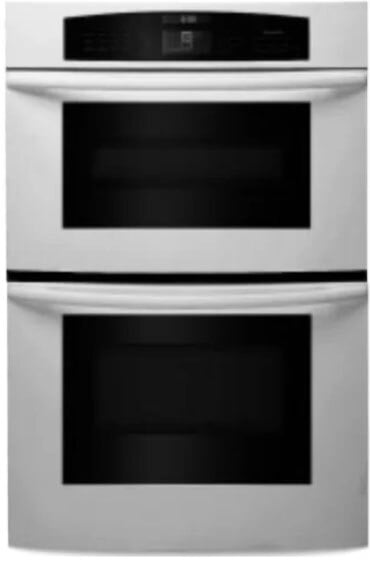
See if this sounds familiar: blast food with high-velocity heated air, combined with microwave energy.
It came from a 1997 partnership with Enersyst, a company that had built air-impingement ovens for restaurants for about two decades.
The JetDirect oven reached the market around 2000.
The idea was good, but the oven had real problems.
It was loud, and Thermador said so in writing. The CJ302 manual warns that the system "results in a higher noise level than standard convection ovens," then adds, "This is normal."
You also had to relearn your recipes.
The manual says JetDirect is not automatic and requires you to reduce the temperature and time yourself, and to think about pan size and material.
That wasn't the only one. Thermador also sold combination microwave and thermal ovens, including the CMT and CM models.
The CM301 and CM302 later drew a Thermador safety notice, because the door might not lock during self-clean on units built before November 2000.
This was Thermador chasing the newest idea like a dog chasing a squirrel, without much interest in how reliable any of its products were at the time.
BSH, the Bosch and Siemens appliance group, had already bought Thermador in 1998, but it wasn't until 2001 that these products and others were discontinued.
Today, if anything, the challenge runs the other way. The Thermador line needs more new ideas.
Maytag Wide-By-Side Refrigerator
At this point, you're probably tired of hearing about cooking products. Let's look at a refrigerator that was supposed to shake up the category.
The Maytag Wide-By-Side was a refrigerator that was more refrigerator than freezer.
Maytag's own patent, granted in 2000, describes a fridge section that is wider at the top and a freezer section that is wider at the bottom.
That shifting divider gave it its look. Look at it, and it's almost slanted, like a Dr. Seuss character designed a fridge.
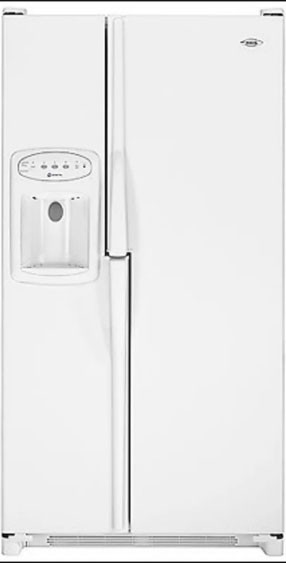 We sold it in the early 2000s, and it failed on looks alone. Maybe they tested it on ten adults. Or maybe, judging by the way it looks, they tested it on ten toddlers instead.
The idea was right, though. You use your fresh-food section every day and your freezer far less, so the fridge deserves the space at eye level.
These days, you're probably buying the same idea without realizing it.
We just call it a French door now: two equal doors on top and a freezer drawer on the bottom, with none of the cartoon proportions.
🔍 ead More: Most Reliable Counter-Depth French Door Refrigerators for 2026, Based on 33,190 Real Service Calls
How Can You Tell If New Appliance Technology Will Last?
Oddly enough, as sad as these five products were, none of them took down the company that made it. The people who lost were the owners, left with an orphaned appliance.
Use the same three tests on anything new you're considering.
- The right kitchen. Does it fit how you cook on a Tuesday night, or how a restaurant cooks ten thousand times a day? Today's speed ovens from Wolf, Miele, and Thermador are designed to work as a normal convection oven when you want them to.
- The right price. Will you use the new feature often enough to pay for it? A feature you use twice a year is a feature you rented.
- The right company. Has the maker supported a new technology for ten years before? Parts and service matter more on a first-generation product, not less.
Ask, too, who will fix it. A new technology needs technicians who have actually seen it fail, which is why we train our own.
What Mistakes Should You Avoid With New Appliance Technology?
Buying the demo. Every one of these products looked great in a showroom, mine included. Picture your actual week, not the best five minutes of the sales pitch.
Buying generation one. First versions carry the most risk. The French door refrigerator did what the Wide-By-Side tried to do, a few years later and with far better looks.
Ignoring the company behind it. Ask how long the brand has made this technology and who services it locally. A good idea from a company that won't stand behind it is still a bad purchase.
🔍 Read More: Do Electronics Really Make Appliances Less Reliable?
The Bottom Line
The five failures here weren't stupid ideas. TurboChef proved its technology every morning at Dunkin', and the Wide-By-Side's idea lives on in every French door refrigerator.
What killed them was fit: the wrong kitchen, the wrong price, or the wrong company, plus one fridge that simply looked wrong. Hold any new appliance technology to those three tests, and you'll avoid owning the next one on this list.

Why Should You Trust Us?
It seems that every appliance review has nothing but glowing comments about almost every product, yet you read customer reviews and they are almost universally bad.
We are here to fill in the disconnect. We'll give you the best features, and the drawbacks as well, including reliability based on over 33,000 calls performed by our service team just last year. Our goal is to give you ALL the information so you know what's right for you.
Please consider subscribing or adding to the conversation in the comments below. We appreciate you stopping by.